How to Stop Getting Stuck in the Downswing
By AI Golf School · Updated · Jump to the video checklist

⚡ Quick Answer & Diagnosis
You get stuck when your lower body outraces your arms in the downswing, trapping the club too far behind you and forcing a block or a flippy snap hook. Fix it by syncing arm speed to your pivot, keeping the trail elbow in front of your torso, and squaring the clubface earlier so you can rotate through without stalling.
Getting stuck is the better player's fault. It usually shows up in golfers who have already learned to swing from the inside and lead with the lower body: but the pivot fires so hard that the arms and club get left behind, trapped too deep behind the torso. From there, there are only two escapes: hold on and block it right, or flip the hands and snap it left.
That two-way miss is the signature. If your bad shots are a push and a hook off the same swing feel, you're not fighting two faults: you're fighting one: the club arriving too late and too far from the inside, needing a perfectly timed hand save every swing.
The fix isn't to abandon the inside path you worked for. It's to re-synchronize the arms with the body and square the face earlier so rotation can continue through impact. An AI swing analysis can confirm whether your arms are genuinely trailing your pivot or whether a laid-off backswing is putting the club behind you before the downswing even starts.
Do blocks and hooks prove my arms are getting stuck?
No. Alternating blocks and hooks can suggest an inconsistent face-to-path relationship, but ball flight alone does not prove your arms are trapped behind your body. Compare your backswing and delivery on video before changing your rotation or hand action.
What to look for in your swing video
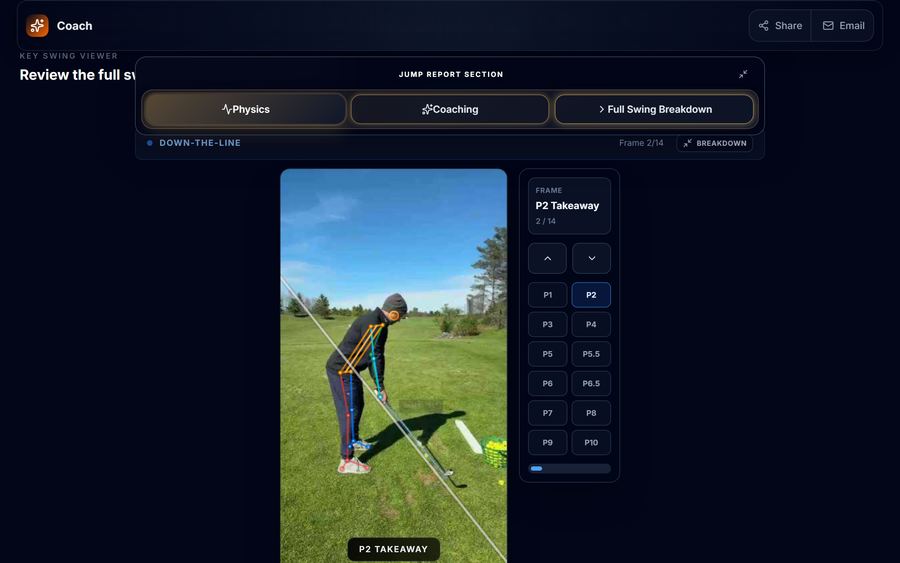
Film down the line near hand height, parallel to the target line, with the full club visible. If possible, record a separate face-on swing for context. Label which swing produced a block or hook so you compare the movement with the actual miss.
- 1. Top of backswing: Check where the hands and club finish relative to your torso. Establish whether the club is already behind you before blaming the downswing sequence.
- 2. Halfway down: Follow the trail elbow and hands as the torso turns. Look for a recurring crowded delivery across several swings; a single camera view can hide the arm behind the body.
- 3. Through the ball: Compare whether the hands and torso continue moving together. Pair this observation with the shot result instead of treating a leftward or rightward exit as a diagnosis on its own.
A single camera flattens depth and can hide the trail arm. Video can suggest a coordination issue, but it cannot prove the cause of every block or hook or precisely measure impact face angle. Compare several swings before selecting a drill.
Try one change at your next practice session
Try the arm-sync drill below using short, relaxed swings. Begin without a ball and keep the arms comfortably connected as you turn. Do not squeeze the towel or pin your elbows rigidly to your ribs. Then hit five easy half shots and record another swing from the same camera position.
Watch the drill: Arm Sync DrillCheck your progress: Look for a less crowded delivery and a more consistent starting direction across the set. Keeping the towel in place is rehearsal feedback, not proof that your full-speed swing is fixed.
Further reading
Why it happens
The pivot outraces the arms
Aggressive lower-body rotation is good: until the arms can't keep pace. When the hips and chest spin open while the arms are still dropping, the club gets trapped behind the body and approaches too far from the inside, leaving the face wide open to the target.
The trail arm gets trapped behind the torso
If the trail elbow slides behind the seam of your shirt in transition, the club is pinned behind you. From there the hands must flip through impact to square the face: the root of the block/snap-hook pattern.
A laid-off or overly flat backswing
When the club points left of target at the top (laid off) or the backswing is too flat and wrapped around the body, the club starts the downswing already behind you. Even a well-sequenced transition can't recover from that starting point.
Narrowing the downswing by dragging the handle
Pulling the grip tight into the body in transition narrows the arc and kills hand speed. The clubhead falls further behind, and the body has to stall and wait for it: the opposite of a synced, rotating strike.
A face that's still open late in the downswing
If the face doesn't start squaring until impact, your brain knows a full-speed body rotation would leave it open, so it stalls the pivot to buy the hands time. Squaring the face earlier is what lets you keep rotating.
How to fix it, step by step
- 1
Re-sequence your downswing with the belt-loop alignment rod drill
Place an alignment rod through your belt loops to monitor your trail side. In transition, feel your trail elbow beat your right pocket to the ball, ensuring your arms and hands stay in front of your body rather than trapped behind your turn.
- 2
Re-sync arms and body with the towel drill
Start with the Arm Sync Drill: a towel across your chest pinned under both armpits, three-quarter swings without letting it drop. If the towel falls, your body outraced your arms. This single constraint teaches the two engines to move at the same speed.
- 3
Keep the trail elbow in front of you
Use the trail-elbow checkpoint from Easy Fix for Trapped Trail Arm: through transition, the trail elbow stays in front of the seam of your shirt, pointing down. Rehearse slow-motion downswings pausing halfway to check it.
- 4
Square the face early so you can keep turning
Run the Two-Piece Move: bow the lead wrist to shallow the shaft while the forearms rotate to square the face, then brush the turf on practice swings and hit low, penetrating shots. With the face squared early, your body no longer needs to stall: you can rotate hard through impact without hooking.
- 5
Restore width and hand speed in transition
Do the Upside Down Extension Drill: club held upside down, extend the hands out away from your body in transition while the lower body rotates forward. This kills the handle-drag that narrows the downswing and leaves the club behind.
- 6
Fix the backswing if the club starts behind you
If video shows a laid-off top position, add the Waiter's Tray feel: trail hand holding a slightly angled tray at the top. It sets the trail wrist and shoulder so the club points at the target, not left of it, and you never start the downswing pre-stuck.
- 7
Train the exit to balance the path
Finish with the exit-path feel from Stop Blocking and Hooking: feel the club exiting low and left around your body after impact. Players who get stuck exit high and right; rehearsing the left exit neutralizes the excessively in-to-out delivery.
The best drills for this fault
Ranked by effectiveness. Each drill page includes step-by-step instructions and a video demonstration.
 1
1Downswing Sequence Alignment Rod Drill
by Porzak Golf
 2
2Arm Sync Drill
by PGA
 3
3Easy Fix for Trapped Trail Arm
by Ian Mellor Golf
 4
4Two-Piece Move to Stop Getting Stuck
by Top Speed Golf
 5
5Upside Down Extension Drill (Hand Speed)
by Kerrod Gray Golf
 6
6Fix Laid Off: The Waiter's Tray
by The Art of Simple Golf
 7
7Stop Blocking and Hooking
by Matt Baker
 8
8Why Amateur Golfers Can't Stay Down & Rotate In The Downswing
by JChownGolf
 9
9Elbow-to-Elbow Connection & Trail-Arm Takeaway Drill
by Harry Shaw Golf
 10
10Why 99% of Golfers instantly improve with this One Move !
by Scott Stiles
Training aids that help
Optional. Every drill above works with a club and an alignment stick - these just make the feedback harder to ignore.
Eyeline Golf Speed Trap
A base plate with 4 velcro rods. It creates a physical 'gate' that forces you to swing in-to-out. If you come Over-the-Top (Slice), you hit the soft rods.
View on AmazonTour Striker Smart Ball (Posture)
Can be used to maintain structure and width, preventing the collapse of the arms that often leads to early extension and loss of spine angle.
View on AmazonSwing Path Trainer
Guides the club path for straight shots.
Search on AmazonAs an Amazon Associate we earn from qualifying purchases.
Frequently asked questions
How do I know I'm stuck and not coming over the top?
They're opposites. Over the top throws the club outside the plane in transition and misses left-to-right (pull or slice). Stuck traps the club too far inside and behind, missing both ways: blocks right and snap hooks left. Video from down the line settles it in one swing: check whether the club approaches above or below your hand plane.
Why do I block it right AND snap hook it left?
Both misses come from the same delivery. The club arrives from deep inside with the face open; if your hands don't save it, the ball blocks right, and if they over-save it, the face slams shut and it snap hooks. Fix the trapped delivery and both misses fade together.
Is getting stuck a sign my lower body is working correctly?
Partly, yes: it usually means you've learned to lead with the lower body, which most amateurs never do. The problem is sync, not sequence. You don't need less lower body; you need arms and face timing that keep up with it.
Why does it happen more with my driver?
The driver's longer shaft and flatter swing plane give the club a longer trip around your body, so any lag in arm speed leaves it further behind. The extra swing speed also amplifies the open-face consequence: a mild push with an iron becomes a 40-yard block with the driver.
Will slowing down my hips fix it?
As a permanent fix, no: you'd be giving up the power your pivot creates. Slowing the hips can be a useful temporary feel while you retrain arm speed and early face squaring, but the durable fix is syncing the arms up, not throttling the body down.