How to Fix a Hook in Golf

⚡ Quick Answer & Diagnosis
A hook happens because your clubface is closed relative to your swing path at impact. Fix it by neutralizing a too-strong grip, stopping your hands from rolling the face shut through impact, and correcting an excessive in-to-out path or a trail arm that gets stuck behind your body in the downswing.
A hook is a shot that starts on line or right of your target (for a right-handed golfer) and then dives hard left, often diving faster and further than you expect. It's the mirror image of a slice, and it's usually the more violent miss: a bad hook can run 30-40 yards offline and into trouble you didn't know was there. It also tends to show up with the driver first, since a closed face relative to path gets amplified with longer clubs and higher swing speeds.
Every hook comes down to one thing at impact: the clubface is closed relative to where the club is traveling. That can come from your grip, from how active your hands are through the ball, from the direction the club is swinging (path), or from your body stalling and forcing your arms and hands to bail you out. Different golfers hook for different combinations of these reasons, which is why two players with the same miss often need completely different fixes.
Because grip, path, and hand action can all produce the same left-curving miss, it's easy to fix the wrong thing and get frustrated when nothing changes. An AI swing analysis can isolate which of these is actually driving your hook from video of your own swing, so you're not guessing at causes that don't apply to you.
Why it happens
A grip that's too strong
If your lead hand is rotated too far to the right on the club (you see three or more knuckles at address) and your trail hand's 'V' points outside your trail shoulder, the clubface starts closed and stays closed unless you actively hold it open. Most hookers never have to 'do' anything wrong with their hands: the grip already has the face shut before the swing starts.
Overactive hands and forearms through impact
Even with a reasonable grip, aggressively rolling the forearms or flipping the wrists through the hitting area closes the face faster than the body is turning. This is a timing issue: the hands are doing work that the body rotation should be doing instead.
An excessive in-to-out swing path
When the club approaches the ball from too far inside the target line and swings out to the right afterward, the face has to close relative to that path just to start the ball online: and a closed face relative to an in-to-out path is a textbook hook or a low, ducking 'snap hook' on the extreme end.
Getting stuck: the trail arm trapped behind the body
If the trail elbow drops behind the seam of your shirt in the downswing, your arms get trapped behind your turning body. From there the only way to deliver the club to the ball is to flip the hands or block-and-release aggressively, both of which shut the face hard through impact.
Ball position and setup center pushed too far back
Your swing rotates around a center point roughly under your lead armpit. If ball position drifts behind that center (too far back in your stance), impact happens right of center, which pulls the path in-to-out and closes the face relative to it, producing a push or a hook instead of a straight shot.
How to fix it, step by step
- 1
Check your grip first
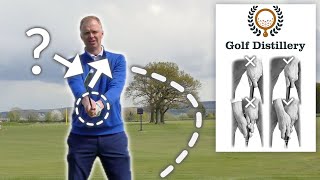
Before touching your swing, rule out the simplest cause. Use the checkpoints from Hooking - Is your Grip Causing your Golf Hooks? to see if your hands are set too strong at address, then work through the Neutral Grip Trainer to build a lead hand showing two knuckles and a trail-hand 'V' pointing at your trail shoulder. Hit small shots and watch the start line before changing anything else.
- 2
If you already play a strong grip, manage it instead of fighting it
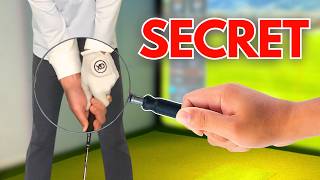
Some players hook because they layer hand roll on top of an already-strong grip. Work through The SECRET to Playing Golf with a Strong Grip routine: soften the grip toward neutral by one checkpoint, hit half-swings focused on body rotation squaring the face, and only build back to full speed once the face stops racing shut at half speed.
- 3
Quiet your hands with the Split-Hand Drill
Slide your trail hand three inches down the grip and make slow, smooth swings. The split grip physically prevents your hands from flipping the club over aggressively, so you feel your body rotation, not your hands, squaring the face through impact.
- 4
Fix the path with a follow-through cue
In the Stop Blocking and Hooking drill, feel the club exit left around your body after impact instead of high and to the right. If your normal miss is a block or a hook, this single follow-through feel neutralizes the excessive in-to-out path causing it.
- 5
Free your trail arm if you're getting stuck
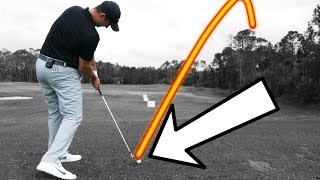
Check your trail elbow position using the Easy Fix for Trapped Trail Arm cue: it should stay in front of your shirt seam, not behind it. If it's trapped, work the Two-Piece Move to Stop Getting Stuck: shallow the club by bowing the lead wrist early, then rotate the forearms to square the face, so your body can rotate through instead of blocking or flipping.
- 6
Keep the club out of the slot behind you
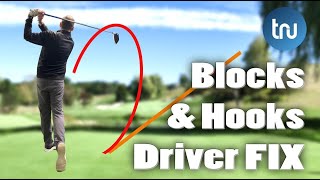
In the Hooks & Blocks Driver Fix drill, keep your lead shoulder low in transition and feel your arms drop toward the ball before your body rotation takes over. That sequencing keeps the shaft parallel to your toe line at the halfway-down checkpoint instead of trapped behind your hands, so you don't have to block or flip to get the face square.
- 7
Confirm your ball position and center
Use Understanding the Center of Your Swing to check that the ball sits off your lead heel and that impact is happening under your lead armpit, not behind it. Hitting right of your swing's center is a direct route to a push or a hook.
The best drills for this fault
Ranked by effectiveness. Each drill page includes step-by-step instructions and a video demonstration.
 1
1Hooking - Is your Grip Causing your Golf Hooks?
by Golf Distillery
 2
2Neutral Grip Trainer
by Danny Maude
 3
3Split-Grip Body Pivot Drill (Punch Cut Feel)
by Scott Cowx
 4
4Split-Hand Drill
by Malaska
 5
5Stop Blocking and Hooking
by Matt Baker
 6
6Hooks & Blocks Driver Fix
by TruGolf Academy
 7
7Downswing Sequence Alignment Rod Drill
by Porzak Golf
 8
8Easy Fix for Trapped Trail Arm
by Ian Mellor Golf
 9
9Two-Piece Move to Stop Getting Stuck
by Top Speed Golf
 10
10The SECRET to Playing Golf with a Strong Grip!
by Harry Shaw Golf
 11
11Understanding the Center of Your Swing
by Danny Maude
Training aids that help
Optional. Every drill above works with a club and an alignment stick - these just make the feedback harder to ignore.
Molded Grip Trainer
A snap-on rubber grip that forces your fingers into the perfect neutral position. The fastest way to fix a weak slice grip or a strong hook grip.
View on AmazonGolf Wrist Hinge Trainer
A wearable brace that clicks or restricts movement if you break your wrists too early. Excellent for curing the 'Flip' or 'Scoop' at impact.
View on AmazonGolf Grip Training Glove
Training glove with placement markings to standardize lead-hand position and reduce grip drift between reps.
View on AmazonAs an Amazon Associate we earn from qualifying purchases.
Frequently asked questions
Why do I hook my driver but not my irons?
Driver is swung faster, with a longer shaft and less loft, all of which amplify a closed face relative to path. The same face-to-path relationship on an iron produces a smaller draw or a pull; on a driver it's magnified into a full hook.
Is a hook the same thing as a draw?
No. A draw is a controlled, moderate right-to-left curve you're aiming for; a hook is an excessive, often unintended version of the same shot shape caused by the face being too closed relative to the path. The mechanics are related, but a hook is the fault version.
Should I fix my grip or my swing path first?
Grip first. It's the simplest checkpoint, it's free to check on every shot, and a strong grip is the most common single cause of a chronic hook. Only move on to path and sequencing drills once you've confirmed the grip isn't the culprit.
How long does it take to stop hooking the ball?
A grip-only hook can improve within a single range session once you feel the new hand position. A hook rooted in getting stuck or an in-to-out path takes longer (usually several focused sessions) because you're retraining a sequencing pattern, not just a static position.
Can equipment cause or hide a hook?
Equipment can exaggerate a hook but rarely causes one outright. A driver with too little loft, a shaft that's too stiff for your tempo, or extreme draw-bias settings can turn a mild in-to-out path into a bigger miss. Fixing the swing first is the reliable route; equipment adjustments are a secondary tweak after that.
Why does my hook get worse under pressure?
Under pressure, golfers tend to grip tighter and swing harder without changing sequencing, which speeds up hand rotation and exaggerates whatever face-closing tendency was already there. If your hook is grip- or hands-based, pressure will expose it first.