How to Fix a Golf Slice
By AI Golf School · Updated · Jump to the video checklist

⚡ Quick Answer & Diagnosis
A slice comes from an open clubface relative to an out-to-in swing path at impact. Fix it by neutralizing a weak grip, adding shoulder tilt at address, and shallowing your downswing so the club approaches from the inside instead of over the top: that squares the face to a path that no longer cuts across the ball.
A slice is a shot that starts left of target (for a right-handed golfer) and curves hard right, often losing 20-40 yards of distance because so much of the strike's energy goes into sidespin instead of forward flight. The strike itself is usually fine to the eye (you're making contact), but the ball flies weak and high with a low, ugly bounce-and-stop on landing.
The root cause is always some combination of two things: the clubface is open relative to where the club is traveling, and the path itself is cutting across the ball from outside to inside the target line (an over-the-top move). You can have an open face with an in-to-out path and still slice, or a square face with a steep out-to-in path and hit a pull: it's the relationship between face and path that curves the ball, not either one alone.
It shows up worse with the driver than with irons for a simple reason: the driver is swung on the shallowest, most upward angle of attack, so any extra steepness or face mismatch gets magnified at higher clubhead speed. An AI swing analysis can show you your actual face angle and path numbers on video, which is the fastest way to know which of the causes below is really yours instead of guessing.
Does a slice always mean you swing over the top?
No. For a centered strike, a clubface open relative to the club path produces slice curvature. The path does not have to travel out to in, and the ball does not have to start left. Record the starting direction and curve separately before choosing a swing change. Directions reverse for left-handed golfers.
What to look for in your swing video
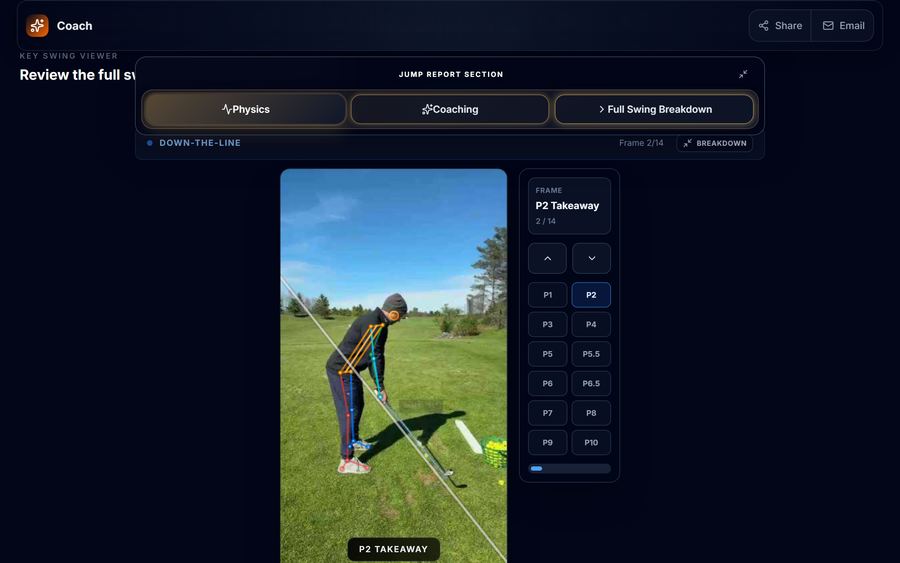
Film down the line with the phone near hand height, aimed parallel to your target line. Keep your feet, hands and the whole club in frame. Record a normal-speed swing in good light and note where the ball started and curved.
- 1. Address: Check where your feet and shoulders aim relative to the target. A camera aimed across the target line can make a neutral setup look open.
- 2. Takeaway: Pause when the shaft is roughly parallel to the ground. Compare the club and hands with your setup; this is an early checkpoint, not a measurement of impact face angle.
- 3. Delivery: Watch the club approach the ball across several frames. Look for a repeatable across-the-ball motion rather than diagnosing a slice from a single still.
A phone video can reveal setup and movement patterns. It cannot reliably establish exact impact face-to-path angles or spin from a blurred clubhead. Off-center driver contact can also change curvature; check strike location before assuming the path is the only cause.
Try one change at your next practice session
Start with the neutral-grip drill below if your setup check suggests a weak grip. Rehearse the grip, then hit five easy half shots. Keep your alignment consistent and record the starting direction and curve of each shot. Change one thing at a time.
Watch the drill: Neutral Grip TrainerCheck your progress: Look for a more repeatable starting direction and less unwanted curve across several shots. If the miss becomes a hook, stop strengthening the grip and reassess the strike and delivery.
Why it happens
Weak or mismatched grip
A weak lead-hand grip (hand rotated too far under the club, fewer than two knuckles visible) makes it mechanically harder to square the face through impact. The body compensates by holding the face open through the hitting area, or the hands try to flip it shut late and inconsistently.
Over-the-top transition (out-to-in path)
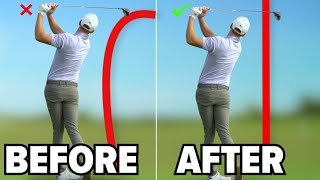
From the top of the backswing, the shoulders and upper body spin toward the target before the arms and club drop into the slot. This throws the club outside the ideal plane, forcing it to cut across the ball from out to in through impact: the single biggest contributor to a slice.
Level or open shoulders at setup
Slicers commonly set up with flat, level shoulders instead of tilting the trail shoulder down and back. Level shoulders promote a steep, over-the-top downswing; the tilt is what creates room to swing more from the inside.
Holding the release (blocked or late hands)
Even with a decent path, if the trail hand never gets the chance to release the clubhead past the handle, the face stays open at impact. This often happens when players are afraid of hooking the ball, so they consciously hold the face open all the way through.
Ball position too far back
Playing the ball back in the stance forces a steeper, more handle-forward strike to reach it in time, which tends to leave the face open relative to the path and steepens the angle of attack: compounding the over-the-top tendency.
How to fix it, step by step
- 1
Check your grip before anything else
Run the Neutral Grip Trainer: hold the club at 45 degrees, set the lead hand so you see two knuckles, and set the trail hand so its 'V' points at your trail shoulder. Confirm this checkpoint before every rep: it's the cheapest fix and often removes half the problem on its own.
- 2
Add shoulder tilt at setup with the driver
Use the Driver Slice Fix (Shoulder Tilt) drill: drop your trail shoulder below your lead shoulder at address and feel your back stay to the target longer in transition. This alone reroutes many over-the-top swings onto an inside path.
- 3
Groove the in-to-out path with a constraint drill
Set up the clock-face stick drill from 'The Best Golf Drill I've Ever Seen': a stick at 4 o'clock you must swing under, and one at 10 o'clock you must finish outside of. Swinging slowly between the two sticks forces the exaggerated in-to-out path that cancels a slice.
- 4
Fix the transition move, not just the path
If the path drill feels impossible to repeat, the leak is in transition. Use Right Knee to Right Field: from the top, drop your hands to your trail pocket and swing out to 'right field' before your shoulders spin open. This retrains the sequence so the path fix in step 3 sticks.
- 5
Retrain the release
Do the Trail-Hand Throw Release Drill at waist height, feeling the trail palm throw the clubhead past the handle after impact like skipping a stone. Add the lead hand back in without gripping harder, then hit soft half shots checking that the face is releasing instead of staying open.
- 6
Test it under speed with a barrier drill
Once the path and release feel real, validate them with the Hovering Alignment Stick Drill: a stick hovering just above the ball on the target line. Start at 40% speed and work up; if you're still coming over the top, you'll hit the stick, which tells you instantly whether the fix has actually transferred to full swings.
The best drills for this fault
Ranked by effectiveness. Each drill page includes step-by-step instructions and a video demonstration.
 1
1GOLF: The Best Golf Drill I've Ever Seen
by Eric Cogorno Golf
 2
2Neutral Grip Trainer
by Danny Maude
 3
3The 'Acorn' Drill (Forearm Supination Feel)
by Scott Cowx
4The Braking Drill (Pivot & Angular Release Control)
by Scott Cowx
 5
5Driver Slice Fix (Shoulder Tilt)
by Kerrod Gray Golf
 6
6Right Knee to Right Field
by Clay Ballard
 7
7How to fix your slice with your driver in 15 seconds
by Get. Golfing
 8
8Hovering Alignment Stick Drill
by GolfPass
 9
9Slice Fix System: Closed Shoulders & 7 O'Clock Entry
by Rick Shiels Golf
Trail-Hand Throw Release Drill
by AI Golf School curated
Training aids that help
Optional. Every drill above works with a club and an alignment stick - these just make the feedback harder to ignore.
Molded Grip Trainer
A snap-on rubber grip that forces your fingers into the perfect neutral position. The fastest way to fix a weak slice grip or a strong hook grip.
View on AmazonEyeline Golf Speed Trap
A base plate with 4 velcro rods. It creates a physical 'gate' that forces you to swing in-to-out. If you come Over-the-Top (Slice), you hit the soft rods.
View on AmazonTour Striker Smart Ball (Connection)
An inflatable lanyard ball held between the forearms. It physically prevents the 'Chicken Wing' and forces the arms and torso to rotate together as a connected unit.
View on AmazonAs an Amazon Associate we earn from qualifying purchases.
Frequently asked questions
Why do I slice my driver but hit my irons fairly straight?
The driver is swung on a shallower plane at higher speed with the ball played forward, so any extra steepness or open-face tendency gets amplified. Irons are hit with a slightly descending, more centered strike that masks a mild path or face issue the driver exposes.
Will a stronger grip fix my slice by itself?
Sometimes, if a weak grip was the main cause. But if your real issue is an over-the-top path, a stronger grip alone can just turn a slice into a pull or a low hook, because you've fixed the face without fixing the path. Diagnose which one is off before changing the grip aggressively.
How long does it usually take to fix a slice?
A grip-only slice can improve within a single range session. A path issue rooted in transition sequencing usually takes several weeks of deliberate drill work at slow speed before it holds up at full speed on the course.
Can equipment changes help while I work on the swing?
A driver with more loft and a shaft that helps you square the face can reduce sidespin and buy you distance in the meantime, but equipment only masks the pattern: it doesn't change the face-to-path relationship causing the curve.
Is a slice the same thing as a weak fade?
No. A controlled fade is a small, intentional left-to-right curve with the face only slightly open to the path. A slice is a large, often unintentional curve where the face is significantly open relative to path, costing distance and accuracy rather than just shaping the shot.
I fixed my path but I'm still slicing: what's going on?
This usually means the clubface is still open relative to your new path, even if the path itself is better. Go back to the grip and release checkpoints: a squared path with an open face still curves right, just less severely.