How to Improve Your Golf Swing Tempo

⚡ Quick Answer & Diagnosis
Slow the backswing down so your body turn, not your hands, starts the club moving, then let the lower body initiate the downswing before your arms react. Most tempo problems are really rushing problems: the transition fires too fast. Train a 3:1 backswing-to-downswing ratio with counting or metronome drills until it's automatic.
Bad tempo doesn't feel like one thing: it feels like a lurch at the top, a backswing that's over before you've turned, or a downswing where the club and your body arrive at different times. The result is the same regardless: inconsistent strike, a face that's never quite square at the same point twice, and shots that go from a pull to a block to a chunk with no pattern you can find on your own.
It happens because the backswing and downswing are supposed to run on different clocks (a slower, wind-up phase and a fast, unwind phase), and most amateurs collapse that difference. The hands and arms take over the takeaway, the body never finishes turning, and by the time the club reaches the top there's nothing left to sequence correctly. The downswing then starts from the wrong parts in the wrong order, usually the upper body and arms firing before the hips have shifted and rotated.
Tempo faults are also one of the easier things to misdiagnose by feel alone: what feels like 'rushing' to one player is actually a sequencing fault, and what feels like 'slow hands' is actually tension in the grip. Running your swing through an AI swing analysis can confirm which of these is actually happening in your motion before you spend range time on the wrong fix.
Why it happens
Arm-dominant takeaway
When the hands and arms snatch the club away instead of the torso rotating it back, the backswing gets short and fast. There's no time left to load the body, so the whole motion feels rushed from the first foot of the swing.
Excess grip and setup tension
Gripping the club too tight, or standing over the ball with tense arms and shoulders, speeds up every muscle that fires next. Tension shortens the backswing and accelerates the transition before the body is in position to use it.
Downswing sequencing fault
In a good downswing the lower body shifts and rotates first, then the torso, then the arms, then the club. When the upper body or arms fire first (the classic 'rushing' move), the sequence inverts, the club gets thrown from the top, and the swing feels like it has no rhythm at all.
No pause or gathering move at the top
The top of the backswing is a change of direction, not a stop, but it still needs a moment where pressure shifts to the lead side before rotation starts. Skipping that gathering move and going straight from backswing momentum into downswing momentum is what makes a swing look 'quick.'
Overswinging to chase distance
Trying to manufacture extra length or speed by swinging harder makes players yank the club back fast and lunge at the downswing to match. Tempo problems often show up first with the driver for exactly this reason: the urge to swing harder is strongest with the longest club.
How to fix it, step by step
- 1
Make the backswing body-driven, not hand-driven
Use the Count to Two Drill: rotate the torso from the belt buckle while counting 'one, two' on the way back. This slows the takeaway and forces the big muscles to load the swing instead of the hands snatching it away.
- 2
Train the 3:1 backswing-to-downswing ratio
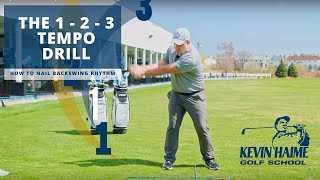
Run the 1-2-3 Tempo Drill, counting '1' on the takeaway, '2' in transition, '3' at impact. The backswing should take roughly three times as long as the downswing: this is the ratio that shows up in almost every efficient swing.
- 3
Kill the rush with a full stop at the top
Do the Pause at the Top Drill: swing to the top, stop completely for a full second, then start down. Pausing removes the arm momentum that causes rushing and forces you to re-initiate the downswing with the lower body.
- 4
Groove the correct order of operations in transition
Use the Step-Through Drill: bring the lead foot to the trail foot at address, then step it back into place as the club swings back. This gives the lower body a head start so it can't get skipped in the sequence.
- 5
Build one continuous motion instead of two separate halves
Work Dr. Kwon's Connection & Rhythm Drill, using the 'one, two, three, and then let it go' count to link the end of the backswing directly to the start of the downswing without a gap or a lurch.
- 6
Lock in the rhythm with external pacing
Once the feel is there, set a metronome to 50-60 BPM and start the takeaway on one click, impact on the next, adjusting the tempo until it matches your natural swing. Use this at the range as a check, not a crutch.
The best drills for this fault
Ranked by effectiveness. Each drill page includes step-by-step instructions and a video demonstration.
 1
1The Count to Two Drill (Torso Engagement)
by Me and My Golf
 2
2Try Our 1-2-3 Tempo Drill for Better Long Irons
by Kevin Haime
 3
3Pause at the Top Drill
by JChownGolf
 4
4The Elephant's Trunk (Sling Drill)
by Athletic Motion Golf
 5
5Dr. Kwon's Connection & Rhythm Drill
by Dr. Kwon (via Chris Como Golf)
6The Step-Through Drill (Hip Sequencing)
by JChownGolf
 7
7Use a Metronome to Find the Perfect Golf Swing Tempo
by Fairway to Green
Lead Hand One-Handed Swings (Weight Flow)
by Adam Bazalgette
Training aids that help
Optional. Every drill above works with a club and an alignment stick - these just make the feedback harder to ignore.
Downshift Board
A dynamic tilt board designed to enhance weight transfer and pressure awareness. Facilitates correct body sequencing by providing physical feedback when shifting pressure.
View on AmazonOrange Whip Trainer
The premier counter-weighted flexible trainer. The counter-weight helps you feel the clubhead throughout the swing, promoting perfect rhythm and balance.
View on AmazonSKLZ Gold Flex Trainer
A heavy, flexible whippy shaft. It forces you to wait for the clubhead in transition, smoothing out jerky tempos and stretching golf-specific muscles.
View on AmazonAs an Amazon Associate we earn from qualifying purchases.
Frequently asked questions
Why does my tempo fall apart with the driver but stay fine with irons?
The urge to swing harder for distance is strongest with the longest club in the bag, and that extra effort is exactly what triggers a rushed takeaway and a lurching transition. Irons naturally get swung with less force, which hides the same tempo fault.
What's the ideal golf swing tempo ratio?
Most efficient swings run close to a 3:1 ratio: the backswing takes about three times as long as the downswing. The exact tempo (fast or slow overall) varies by player, but the ratio between the two halves stays consistent.
Is a slow backswing always the fix for bad tempo?
Not by itself. Slowing the backswing helps, but if the downswing sequencing is still backwards (upper body firing before the lower body shifts), a slower backswing just delays the same rushed transition. Fix the sequence, then slow the takeaway.
Will using a metronome actually change my swing, or just my practice swings?
It works best as a training aid, not a permanent habit. Use it to find and feel your natural rhythm during range sessions, then wean off it so the tempo becomes internal rather than something you're counting along to on the course.
How long does it take to fix rushed tempo?
Most players feel a difference within a single focused range session once they isolate whether the issue is the takeaway, the transition, or both. Making it hold up under pressure on the course typically takes several weeks of repetition.
Can swing speed training make my tempo worse?
It can if you carry the 'swing harder' intent from speed training drills straight into normal ball-striking. Keep speed work and tempo work separate, and check your ratio with a counting or metronome drill after any speed-focused session.