Smash Factor in Golf: What the Number Means and How to Raise It

Quick answer
Smash factor is ball speed divided by club speed. On a driver, tour players average 1.49 and the average golfer sits around 1.42, with a conforming driver topping out near 1.50. If your driver number is below 1.42, off-center contact is almost always the reason, and the fix is in your delivery rather than in your effort.
Swing 100 mph and produce 142 mph of ball speed and your smash factor is 1.42. Produce 149 mph at the same club speed and it is 1.49. Same effort, seven more miles per hour of ball speed, and TrackMan puts a 10 mph ball speed gap at roughly 20 yards. That is the whole appeal of the number: it is the one distance lever that does not require you to swing harder.
What smash factor actually measures
Ball speed is what survives the collision. Smash factor captures how much of your clubhead's energy reached the ball instead of leaking into vibration, off-axis spin, and heat.
Three things drive that transfer: where on the face you struck the ball, how springy the face is, and spin loft, which is the gap between dynamic loft and attack angle. Catch the middle of the face with a square face and sensible spin loft and you get the maximum available transfer. Miss an inch toward the toe and you lose ball speed and add gear-effect spin you did not ask for.
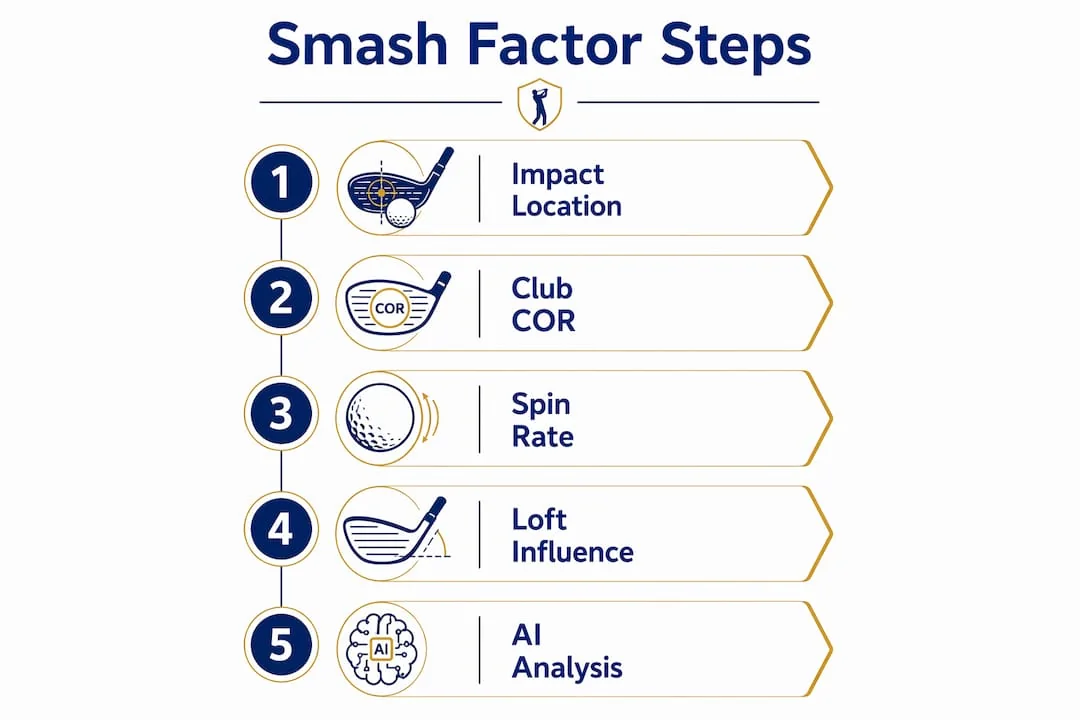
Face springiness has a hard legal ceiling. The USGA caps spring-like effect at a coefficient of restitution of 0.822, enforced through a characteristic time limit of 239 microseconds plus an 18 microsecond test tolerance. That cap is why a conforming driver tops out at roughly 1.50 and why tour averages sit at 1.49 rather than somewhere higher. A launch monitor reading above 1.50 is usually measurement noise or non-conforming equipment, not elite ball striking.
The benchmarks that are worth knowing
| Club and player | Smash factor |
|---|---|
| Driver, PGA Tour and LPGA Tour average | 1.49 |
| Driver, average golfer | 1.42 |
| Driver, practical ceiling for a conforming club | About 1.50 |
| 6-iron, PGA Tour | 1.39 |
| 7-iron, PGA Tour | 1.34 |
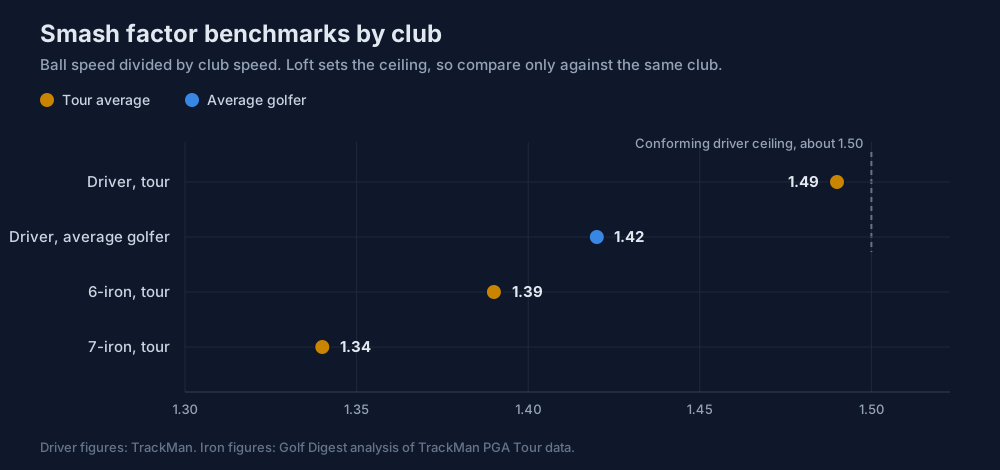
Loft sets the ceiling for each club, so the only comparison that means anything is your number against the benchmark for that same club. A wedge produces a far lower smash factor than a driver because the oblique strike sends energy into spin and height rather than forward ball speed. That is design, not a fault.
This is also why smash factor is close to useless for comparing iron models against each other. Golf Digest makes the point directly: 7-iron lofts on their Hot List span seven degrees, from 27 to 34, and a stronger-lofted 7-iron will post a higher smash factor with identical striking. Before you conclude one iron is better than another on the strength of that number, check the lofts.
How smash factor gets measured
Smash factor requires measuring two speeds at impact, which means radar or high-speed cameras. Lab-grade launch monitors are the reliable source. Consumer units are good enough to track your own trend over time, which is usually all you need.
| Device | How it measures | Where it fits |
|---|---|---|
| TrackMan 4 | Dual radar | The tour-level fitting and teaching standard |
| FlightScope X3 | Radar fused with camera | Full flight and club data, indoor or outdoor |
| Foresight GCQuad | Quad camera | The indoor fitting standard, valued for face-impact location |
| SkyTrak+ | Photometric | Home simulators and regular practice at a fraction of the cost |
| Phone video and AI analysis | Pose and club tracking from video | No ball speed at all. Reads the delivery that produced the strike |
That last row is worth being clear about, because the category gets blurred in marketing all the time. Video analysis does not measure smash factor. There is no radar, no ball speed, and no face-impact map. What it reads is the swing that produced the number, which turns out to be the part the launch monitor cannot tell you.
Diagnosing a low smash factor
Work through this in order. Skipping to step six is how people end up buying a shaft to fix a low point problem.
- 1
Check where you are hitting the face
Impact spray or tape, five shots, look at the pattern. Consistently off-center strikes are your answer and nothing further down this list matters until they move. A toe strike an inch from center costs real ball speed and adds gear-effect spin on top.
- 2
Check attack angle
A steep descending blow with a driver inflates spin loft and suppresses smash factor. A slightly positive attack angle is the target with a driver.
- 3
Check dynamic loft
Too much, from a weak grip or an early release, bleeds energy into spin. Too little kills launch and you lose the distance a different way.
- 4
Check face relative to path
A large gap between face and path launches the ball off-axis and wastes transfer, on top of sending it somewhere you did not aim.
- 5
Check shaft and tempo
A shaft that is wrong for your transition delivers the head in the wrong place, and you compensate, and the compensation moves the strike off center.
- 6
Only then look at equipment
If the first five look reasonable and the number is still low, now shaft flex, lie angle and loft are worth paying someone to sort out.
Drills that move the number
Every one of these works on centered contact rather than on the number itself. Gaining 0.05 of smash factor at 100 mph of club speed is five extra miles per hour of ball speed, which on TrackMan's own conversion is worth about ten yards. You will not find ten yards faster anywhere else.
Start with impact tape. Ten shots, no swing thought, just look at where the marks land. If they cluster toward the toe you are standing too far from the ball or losing your posture coming down, and the pattern tells you which. This is the highest return drill in golf for the effort involved, and almost nobody does it.
Then the tee gate. Put two tees either side of the ball so the clubhead has to pass through a narrow gate cleanly. FlightScope recommends this one specifically because the smash factor reading on the next shot gives you immediate feedback on whether the delivery got cleaner. The constraint does the coaching.
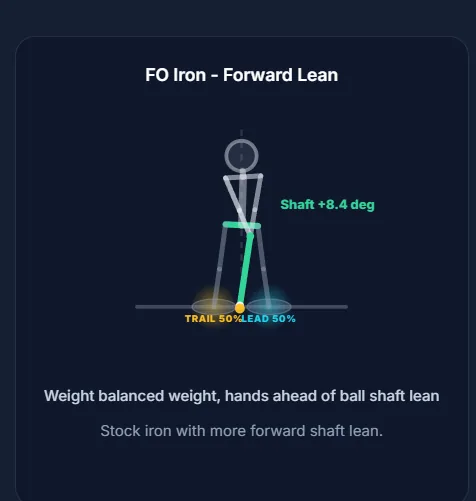
Third, rehearse impact slowly and stop there. Swing to impact at about a third of speed and hold the position, then check shaft lean, face angle and where your weight is. Most golfers carry a mental picture of impact that does not match what they actually do, and the gap between the two is where the improvement is hiding. Film it on your phone and compare it against your full-speed swing.
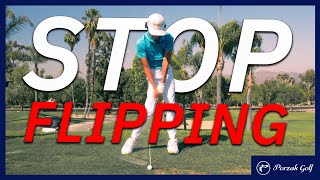
Four drills for the causes behind a low number
These come from the library of 140 instructor-sourced drills, each tagged with the fault it addresses.



| Week | Focus | What you are checking |
|---|---|---|
| 1 | Impact tape and the tee gate | The strike pattern moves toward the center of the face |
| 2 | Slow-motion impact rehearsals with video | Face angle and shaft lean at impact match what you intended |
| 3 | Full-speed swings on a launch monitor | Smash factor average moves off your week-one baseline |
| 4 | On-course, then retest the baseline | The number holds up when the shot matters |
When it is the equipment
If your impact pattern is centered, your delivery numbers look sane, and the smash factor is still under the benchmark for that club, the equipment is the remaining suspect.
- A shaft that is too stiff for your transition delivers the head late and low on the face
- A lie angle that is too upright or too flat tilts the face at impact and pushes strikes off center in a consistent direction
- A driver loft that does not match your attack angle leaves you with too much or too little spin loft
- A worn face on an older driver has lost some of the springiness it shipped with
- A ball that is too firm for your speed never fully compresses
Bring data to a fitting. Your baseline smash factor average, your attack angle, and your ball speed numbers let the fitter work on shaft and head variables instead of spending the first half of the session diagnosing your swing from scratch. Ask specifically for a face-impact map, because without it you cannot tell whether a new shaft improved your contact or just changed your ball flight.
What video analysis adds, and what it does not

A launch monitor tells you your smash factor is 1.43. It does not tell you why, and that is not a criticism of launch monitors. Measuring the collision and diagnosing the motion that caused it are different jobs.
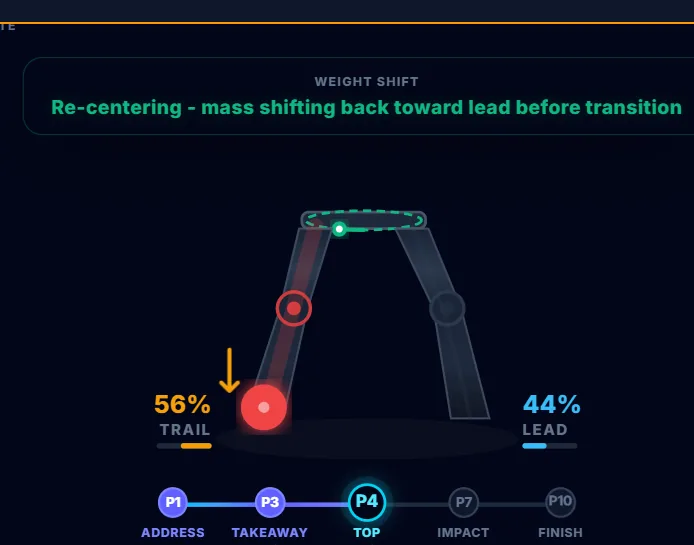
Off-center contact is a symptom. Behind it is usually one of a short list of delivery faults, and those are readable from video. Standing up through impact moves your low point and your distance from the ball. An early release burns your shaft lean before you arrive. Swaying off the ball moves the whole swing center, so the club returns to a place the ball is not. Getting the hands stuck behind the body sends the strike toward the heel.
AI Golf School reads that side of it. Upload a swing and the physics engine measures club path, tempo, weight shift, X-factor and pressure shift, then names the faults it found and marks the one driving the others. It has no idea what your ball speed was. What it can tell you is which part of your delivery is making centered contact hard, which is the question the launch monitor left open.
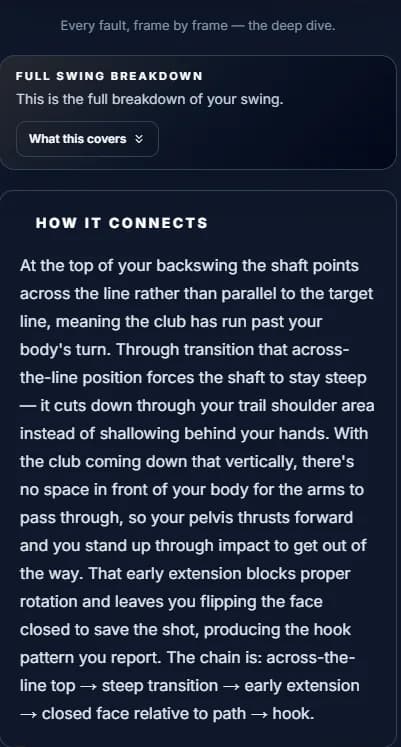
The delivery faults behind most low numbers
Each guide covers root causes and the drills that address them.
Used together the two are straightforward. The launch monitor sets your baseline and confirms whether anything changed. The video analysis tells you what to work on between those sessions. Neither one replaces the other, and the honest version of the pitch is that they answer different questions. More on how the video side works in our guide to AI swing analysis.
When to book a lesson or a fitting
Three triggers. Your smash factor sits consistently below the benchmark for the club. Your impact pattern is scattered across the face with no direction to it. Or your launch and spin numbers do not add up against the distance you are getting.
- A five to ten shot baseline average, same ball, same tee, no swing thoughts
- Recent launch monitor data including attack angle and dynamic loft
- Video of your swing from face-on and down-the-line
- The ball and tee height you actually use on the course, not the range rocks
Retesting the same way every time is what separates a real improvement from a good day. It is dull, and it is the part most golfers skip, and it is the reason they cannot tell you whether anything they did last season worked.
Key takeaways
| Point | Details |
|---|---|
| Check the strike before anything else | Impact tape shows off-center patterns in five shots. Nothing further down the diagnostic list matters until that pattern moves toward the center. |
| Compare against the same club | Tour driver average is 1.49 and tour 7-iron average is 1.34. Comparing smash factor across clubs, or across irons with different lofts, produces conclusions that are simply wrong. |
| The ceiling is a rule, not a skill limit | The USGA caps face spring effect at 0.822 COR, which puts a conforming driver at roughly 1.50. Readings above that are noise or non-conforming equipment. |
| 0.05 of smash is about ten yards | At 100 mph of club speed, moving from 1.42 to 1.47 adds five mph of ball speed, which TrackMan's conversion puts at roughly ten yards. No extra effort involved. |
| Video finds the cause, not the number | Smash factor needs a launch monitor. The delivery faults that cost you centered contact are readable from a phone video, and that is the part you can practice. |
Frequently asked questions
What is a good smash factor for a driver?
PGA Tour and LPGA Tour players average 1.49 on driver, and the average golfer sits around 1.42. A conforming driver tops out at roughly 1.50 because of the USGA limit on face spring effect, so anything from 1.45 upward represents solid centered contact.
Why is my smash factor lower with irons than with my driver?
Loft. A more lofted club delivers a more glancing blow, so more energy goes into spin and launch height rather than forward ball speed. PGA Tour players average 1.39 with a 6-iron and 1.34 with a 7-iron, against 1.49 with a driver. Compare your number against the same club, never across clubs.
Can I measure smash factor without a launch monitor?
No. Smash factor requires measuring both ball speed and club speed at impact, which needs radar or high-speed cameras. Video analysis cannot produce the number. What it can do is read the delivery faults behind off-center contact, which is where the number actually comes from.
How do I raise my smash factor?
Move your strike toward the center of the face. Start with impact tape to see the current pattern, use a tee gate drill to clean up the delivery path, and rehearse impact in slow motion so your actual impact position matches the one you think you are making. Equipment changes come last, after the strike pattern has stopped moving around.
Is smash factor useful for comparing irons?
Not on its own. Golf Digest points out that 7-iron lofts across a single year's models can span seven degrees, and a stronger-lofted iron posts a higher smash factor with identical striking. Check the lofts before drawing any conclusion from the number.
Sources
- TrackMan: What is smash factor in golf? Definition, tour and amateur averages, and the ball speed to distance conversion.
- FlightScope: Optimizing smash factor in golf The tee gate drill and how centered impact drives the reading.
- Golf Digest: The most deceiving data point when comparing irons Tour 6-iron and 7-iron smash factors, and the seven-degree loft spread across Hot List 7-irons.
- USGA: The Equipment Rules The 0.822 COR limit and the 239 microsecond characteristic time test.
How AI Golf School Diagnoses Your Swing
Instead of a vague list of swing tips, every analysis isolates your single root-cause fault, tracks 33 skeletal joints in 3D through impact, and pairs you with a focused drill plan.

Composite score with root-cause flaw detection and severity ratings.
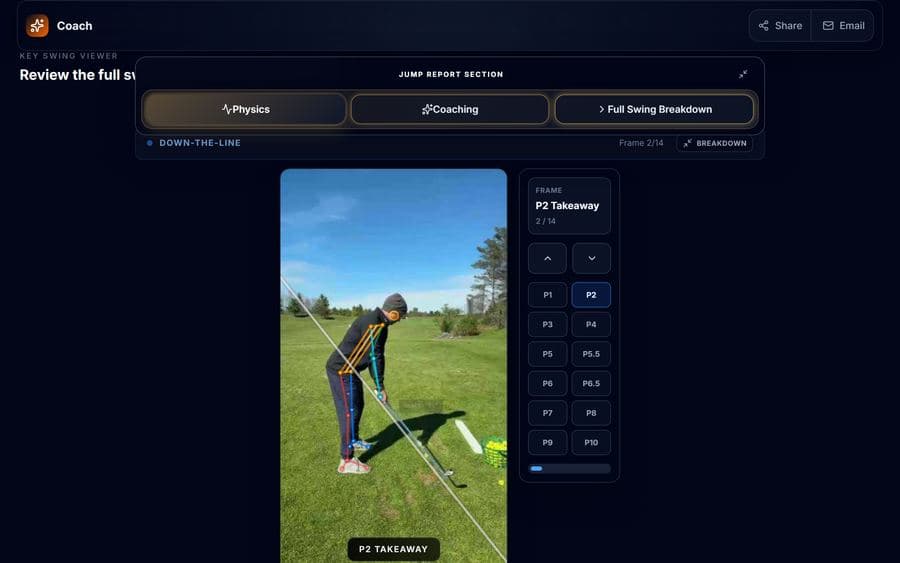
The Oracle physics engine tracks 33 joints across all swing phases.

Personalized drills from certified coaches matched to your specific flaws.
Upload one video from your phone to diagnose your swing mechanics.