How to Stop Topping and Thinning the Golf Ball

⚡ Quick Answer & Diagnosis
You top or thin the ball because the club's low point is behind the ball or your swing center rises before impact. Fix it by keeping your sternum steady, shifting pressure onto your lead foot before impact, and committing to a descending strike that clips the turf after the ball: not by trying to lift the ball up.
A topped shot is the most deflating miss in golf: the leading edge strikes the top half of the ball and it dribbles a few yards forward. A thin shot is its slightly better cousin: the leading edge catches the ball's equator and sends it screaming low across the green. Both misses come from the same root problem: the club reaches the bottom of its arc too early or too high.
The instinct that causes most topped shots is the urge to help the ball into the air. Golfers hang back on the trail foot, bend the lead arm to avoid hitting the ground, or lift the chest through impact: and every one of those moves raises the club just enough to catch the ball thin. The fix is always the opposite of the instinct: hit down and let the loft do the lifting.
Because the causes overlap (hanging back, standing up, arm collapse), it can be hard to self-diagnose from ball flight alone. An AI swing analysis can show you whether your swing center is rising or your weight is stuck on the trail side, so you work on the version of the fix that actually applies to you.
Why it happens
Fear of hitting the ground
Many golfers subconsciously avoid taking a divot, so they bend the lead arm or pull up through impact to protect against the 'fat' miss. Shortening the swing radius this way raises the clubhead, and the leading edge catches the top of the ball instead of compressing it.
Hanging back on the trail foot
The low point of the swing arc follows your pressure. If your weight stays on the trail side through impact, the arc bottoms out behind the ball and the club is already traveling upward when it arrives: thin or topped contact is the mechanical result.
The swing center rising before impact
If your head and sternum lift during the downswing (standing up out of posture or early-extending the hips toward the ball), the whole arc rises with them. Even a one-inch lift is enough to turn a solid strike into a thin one.
Ball position too far forward
With an iron played too far forward in the stance, the club reaches its low point before the ball and is ascending at contact. Combined with even a small sway or hang-back, that ascending strike becomes a top.
Swaying off the ball
Sliding the hips laterally in the backswing moves the entire arc behind the ball. Unless you make a perfectly timed slide back, the low point stays behind the ball and contact comes off the leading edge.
How to fix it, step by step
- 1
Reset ball position and setup
Use the ball-position check from the Topping Fix (3-Point Low Point Control) drill: feet together with the ball centered, then one step toward the target and one step away. For mid-irons the ball should sit roughly under your shirt buttons: not off your lead toe.
- 2
Retrain the descending strike with a tee
Run the Three-Step Drill: clip a low tee out of the ground with no ball, then with a ball on the tee, then with the ball alone while imagining the tee underneath. This removes the fear of the ground and proves your low point is in the right place.
- 3
Keep your swing center steady
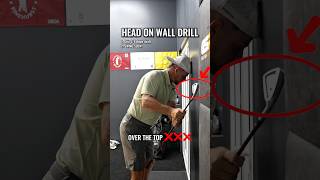
Do the Head-on-Wall Posture Drill: forehead lightly on a wall, arms crossed, rotating back and through without the head leaving the wall. If you're a 'stander-upper,' this is the feel that stops the arc from rising.
- 4
Get your pressure onto the lead side before impact
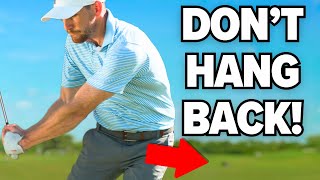
Use the Stepping and Striking Drill: step onto the lead foot as you start the downswing and plant it before you swing through. Low point follows weight; planting the lead foot moves the bottom of the arc in front of the ball where it belongs.
- 5
Stay in your posture through the strike
If video shows your hips thrusting toward the ball, add the Chair Drill for Early Extension: keep your glutes in contact with a chair or bag from address through impact. Early extension raises the handle and the arc with it.
- 6
Finish with a balance check
End each range session with the Feet Together Drill at three-quarter speed. If you can clip the grass cleanly with no base of support, your contact is coming from rotation around a stable center: not from timing a lift.
The best drills for this fault
Ranked by effectiveness. Each drill page includes step-by-step instructions and a video demonstration.
 1
1The Three-Step Drill (Tee Clip)
by Golf with MAGS
 2
2Topping Fix (3-Point Low Point Control)
by US GOLF TV
 3
3Head-on-Wall Posture Drill
by Home Golf Drills
 4
4Stepping and Striking Drill (Dynamic Transfer)
by Kerrod Gray Golf
 5
5Chair Drill for Early Extension
by Matthew Galley
 6
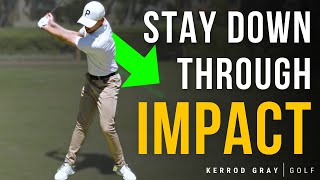
6Stay Down Through Impact (3-Part Sequence)
by Kerrod Gray Golf
 7
7Feet Together Drill
by US Golf TV
Training aids that help
Optional. Every drill above works with a club and an alignment stick - these just make the feedback harder to ignore.
Downshift Board
A dynamic tilt board designed to enhance weight transfer and pressure awareness. Facilitates correct body sequencing by providing physical feedback when shifting pressure.
View on AmazonTotal Golf Trainer - Hip
A foam rod that attaches to your belt buckle. It gives instant feedback if you slide your hips (sway) or lose your posture (early extension).
View on AmazonPower Plate
Training aid for improving weight transfer and balance.
Search on AmazonAs an Amazon Associate we earn from qualifying purchases.
Frequently asked questions
Why do I top the ball with my fairway woods but not my irons?
Fairway woods have a shallow face and a long shaft, so the margin at the bottom of the arc is tiny. Any hang-back or lift that an iron's loft would partially rescue turns into a clean top with a 3-wood. The fix is the same: lead-side pressure and a steady sternum. The wood just exposes it sooner.
Should I keep my head down to stop topping the ball?
'Head down' is the most common and least useful advice for topping. The problem isn't your eyes: it's a rising swing center or a low point behind the ball. Forcing the head down without fixing pressure shift often makes contact worse and stalls your rotation.
Am I topping it because I'm lifting my arms?
Bent arms at impact are usually a symptom, not the cause. Golfers bend the lead arm to avoid hitting the ground: a fear response. Drills that prove the ground is safe to hit, like clipping a tee, straighten the arms naturally.
Is topping caused by swinging too hard?
Indirectly, yes. Swinging harder than you can balance causes sway, hang-back, and early standing: all of which raise the low point. If your tops show up mid-round when you chase distance, throttle to 80% and the contact usually returns.
How long does it take to stop topping the ball?
Setup and ball-position tops can disappear in one session. Pattern tops driven by hanging back or standing up typically need two to four weeks of low-point drills before the new strike survives on-course pressure.