How to Stop Swaying in the Golf Swing

⚡ Quick Answer & Diagnosis
Swaying happens when your hips slide laterally in the backswing instead of rotating, moving your swing center off the ball and dragging the low point with it. Fix it by keeping pressure on the inside of your trail foot and turning your trail hip back and around: coil around a stable axis instead of drifting off it.
A sway is lateral drift disguised as a turn. Instead of the trail hip rotating back and around in the backswing, it slides away from the target: taking your head, sternum, and the bottom of your swing arc with it. Unless you time a perfect slide back to the ball, you're left hitting fat and thin shots from a swing center that's in a different place every rep.
The fault usually comes from a well-intentioned idea: 'shift your weight to the trail side.' Golfers hear that and push their mass laterally onto the outside of the trail foot. Real loading is rotational: pressure moves to the inside of the trail foot while the hip turns behind you, coiling against a stable base rather than drifting off it.
Sway and its close cousins (sliding toward the target in the downswing, and the reverse pivot) are hard to feel because they all masquerade as 'weight shift.' An AI swing analysis can measure how much your head and hips actually move laterally, which tells you whether you're a swayer, a slider, or both.
Why it happens
Misunderstanding weight shift as lateral movement
The most common cause is conceptual: treating the backswing as a slide onto the trail side. Correct loading is a pressure shift into the inside of the trail foot paired with hip rotation: the mass stays centered while pressure and coil build.
Pressure rolling to the outside of the trail foot
Once pressure leaks to the outside edge of the trail foot, the hip has nowhere to rotate and the body keeps drifting laterally. The inside edge of the trail foot is the wall the backswing loads against: lose it and you sway.
Restricted trail-hip internal rotation
If your trail hip physically can't rotate internally (common with limited mobility or a square-set trail foot), the body satisfies the 'turn' instruction the only way it can: by sliding. Flaring the trail foot out often unlocks the turn immediately.
A flat, armsy backswing with no coil
When the shoulders tilt or the arms lift without the hips turning, something has to move to create the feeling of a backswing: and that something is usually a lateral drift of the pelvis.
Swinging harder than you can balance
Chasing distance amplifies every lateral tendency. If your sway shows up mainly on driver swings or when you go after one, the speed is outrunning your ability to stay centered.
How to fix it, step by step
- 1
Fix the concept before the movement
Internalize the reframe from Chris Ryan's 'Weight Shift Is Ruining Your Game': think pressure shift, not weight shift. Pressure moves early to the inside of the trail foot while your center stays put. Most swayers improve just by abandoning the slide-right mental model.
- 2
Put a barrier outside your trail foot
Use Danny Maude's Trail Foot Barrier Drill: a ball or rolled towel against the outside of the trail foot, then make backswings feeling a 'spiral staircase' motion: up and around. If you sway, you feel the barrier instantly. Keep pressure on the inside of the trail foot the whole way.
- 3
Anchor the lead side for instant feedback
Try Mark Crossfield's Lead Hand Anchor Drill: hold a vertical club outside your lead foot with your lead hand and make trail-arm-only backswings. The anchor makes lateral drift physically obvious: you cannot sway without shoving the vertical club toward the target.
- 4
Test and unlock your trail hip
Run the Hip Rotation Test with the flared trail foot from Me and My Golf. If internal rotation is what's blocking your turn, flaring the trail foot a few degrees more unlocks a full coil: and the sway disappears because the body no longer needs it. Pair it with the Swap Pockets cue: trail front pocket moves to where the back pocket was.
- 5
Groove rotation with feet together
Hit balls with Pete Cowen's Feet Together Drill: five three-quarter shots with feet touching, then one normal swing. With no base to slide across, your body learns to turn inside a barrel. It's also a built-in governor: if you fall over, you're swinging harder than you can balance.
- 6
Stop the downswing slide too
If you sway back and then slide toward the target, add the Alignment Stick Bump Drill: stick planted a fist outside the lead hip, bump it lightly in transition, then extend up and rotate so the belt buckle stays on the stick line. One bump, then turn: not a drift.
The best drills for this fault
Ranked by effectiveness. Each drill page includes step-by-step instructions and a video demonstration.
 1
1Trail Foot Barrier Drill (Anti-Sway)
by Danny Maude
 2
2Lead Hand Anchor Drill (Fastest Sway Fix)
by Mark Crossfield
 3
3Weight Shift Is Ruining Your Game
by Chris Ryan Golf
 4
4Hip Rotation Test/Flare Out Foot Drill (Internal Rotation)
by Me and My Golf
 5
5Pete Cowen's Feet Together Drill (Anti-Slide)
by Kerrod Gray Golf
 6
6Stop Swaying (Alignment Stick Barriers)
by Titleist Tips
 7
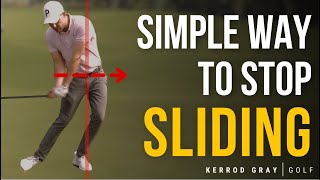
7Alignment Stick Bump Drill (Extension)
by Kerrod Gray Golf
8Swap Pockets Drill
by Me and My Golf
Training aids that help
Optional. Every drill above works with a club and an alignment stick - these just make the feedback harder to ignore.
Callaway Power Platform
A wedge-shaped device you stand on. It forces your weight to the inside of the foot, preventing 'Swaying' and encouraging proper pressure shift.
View on AmazonDownshift Board
A dynamic tilt board designed to enhance weight transfer and pressure awareness. Facilitates correct body sequencing by providing physical feedback when shifting pressure.
View on AmazonPower Plate
Training aid for improving weight transfer and balance.
Search on AmazonAs an Amazon Associate we earn from qualifying purchases.
Frequently asked questions
What's the difference between swaying and sliding?
Direction. Swaying is excess lateral drift away from the target in the backswing; sliding is excess lateral drift toward the target in the downswing. Many golfers do both, and the fix for each is the same principle: convert lateral motion into rotation around a stable axis.
Isn't some lateral movement normal in a good golf swing?
Yes. A small, early pressure shift and a modest re-centering move toward the target in transition are part of every good swing. The fault is degree: when your head and pelvis drift enough that the low point moves with them, lateral motion has replaced rotation instead of supporting it.
Why does swaying cause fat and thin shots?
The bottom of your swing arc sits under your swing center. Sway off the ball and the low point moves back with you: hit the ground early (fat) or catch the ball on the upswing (thin). Contact becomes a timing gamble on whether you slide back in time.
Does swaying cost me power?
Yes, badly. Power comes from coil: the stretch between a turning upper body and a resisting lower body. A sway releases that stretch as sideways drift, so you arrive at the top with movement but no torque. Fixing a sway usually adds speed rather than costing it.
Can poor hip mobility be the real cause of my sway?
Often, yes. If your trail hip lacks internal rotation, your body slides because it can't turn. Test it with the flare-out foot drill: if flaring the trail foot instantly deepens your turn, work with the flare rather than fighting your anatomy.