How to Stop Getting Stuck in the Downswing: Hip Clearance and Arm Flow

Key takeaways
| Point | Details |
|---|---|
| Getting stuck occurs when the trail elbow drops behind the body seam | The arms cannot reach the ball from the inside without severe hand-flipping compensations through impact. |
| Spinning the hips too fast too early is the primary cause | When the pelvis rotates violently before the hands drop to chest height, the trail arm is trapped against the back of the torso. |
| The two-way miss is the signature symptom | Stuck swings cause wild high pushes to the right and violent duck hooks to the left from late emergency hand flips. |
Quick answer
Getting stuck occurs when your hips spin open too rapidly in transition, trapping your trail elbow behind your hip seam and leaving the clubhead stranded behind your body. To stop getting stuck, let your arms drop in front of your chest before aggressively rotating your hips, keeping the trail elbow connected to the front of your ribcage.
You have worked hard on shallowing the club. You stopped coming over the top, you learned to drop the club from the inside, and you started firing your hips toward the target. But instead of hitting pure high draws, you are suddenly battling the most frustrating two-way miss in golf: a push-block 40 yards right, followed by a violent hook into the left trees.
Welcome to the trap of getting stuck. It is the curse of the athletic golfer: swinging with great flexibility and fast hips, but with arms that trail too far behind the body rotational train.
The anatomy of a trapped trail arm
At address, your arms and hands sit in front of your chest. In a sound downswing, your arms must stay in front of your chest as your body turns through the ball.
When you get stuck, your lower body spins open so fast that your trail elbow gets pinned against the back of your right hip (for a right-handed player). From that trapped position, the club cannot reach the ball cleanly. Your brain realizes this at position P6, stalls your hip rotation abruptly, and flips the clubhead with the wrists.

| Swing Segment | Tour Synchronized Delivery | Stuck Amateur Swing | Impact Miss Pattern |
|---|---|---|---|
| P5 Trail Elbow Placement | In front of right ribcage | Pinned behind trail hip seam | Club drops severely under plane |
| Pelvis-to-Thorax Separation | Pelvis leads chest by 15° to 20° | Pelvis outruns chest by 35°+ | Kinematic lag disconnect |
| P6 Hand Path Alignment | In front of chest center | Trapped behind trail hip pocket | Forces hip rotation to stall completely |
| P7 Impact Release | Continuous body rotation clear | Emergency wrist flip scoop | Two-way miss: push-block or snap hook |
Targeted drills to keep your arms in front
Work through these practice drills to synchronize your downswing and free your trail arm from the hip seam.
Essential anti-stuck drills
Practice these sequencing drills to guide your trail elbow in front of your ribcage before impact.


Explore our dedicated fault guide
Connected swing fault guides
Getting stuck is closely linked with hip rotation timing and early extension.
Frequently asked questions
What does getting stuck feel like in the golf swing?
It feels like your arms are trailing far behind your body turn, forcing you to stall your pivot through impact and flick your wrists desperately to save the strike.
Why do good golfers struggle with getting stuck more than high handicappers?
High handicappers usually come over the top with an open chest. Good players understand that they need an in-to-out path, so they drop the club shallow and fire their hips hard. If the arms do not fall in front of the chest first, the player gets trapped.
Sources
- Titleist Performance Institute Upper/Lower Body Separation Studies Kinematic sequencing and trail elbow positioning.
- PGA Tour Biomechanics Handoff Report Analysis of hip rotation speeds vs arm speed in elite players.
How AI Golf School Diagnoses Your Swing
Instead of a vague list of swing tips, every analysis isolates your single root-cause fault, tracks 33 skeletal joints in 3D through impact, and pairs you with a focused drill plan.
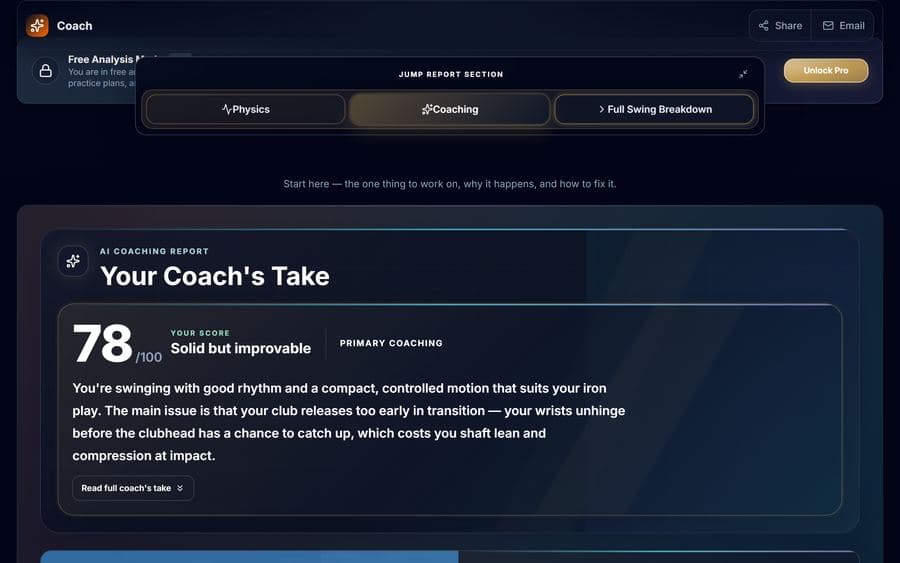
Composite score with root-cause flaw detection and severity ratings.

Swing Lens tracks 33 joints across all swing phases.

Personalized drills from certified coaches matched to your specific flaws.
Upload one video from your phone to diagnose your swing mechanics.