C-Posture and S-Posture in Golf: How Address Spine Angle Shapes Your Swing
Key takeaways
| Point | Details |
|---|---|
| C-posture is excessive thoracic rounding across the upper back and shoulders | Slumping over the ball locks the thoracic spine, cutting shoulder turn in half and forcing your arms to lift independently or stand up during the backswing. |
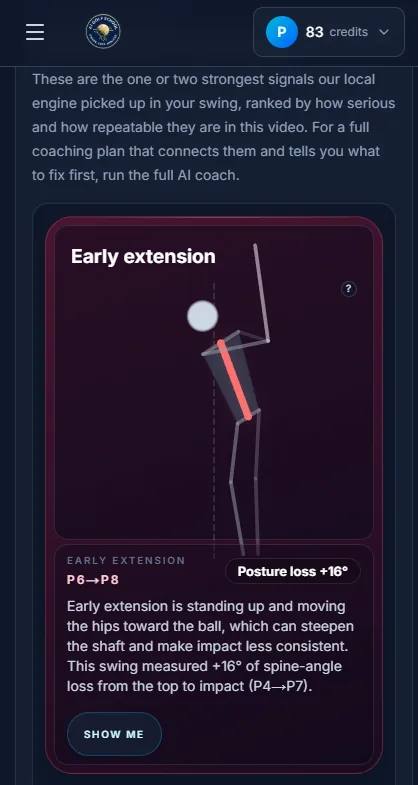
| S-posture is excessive lumbar arch caused by sticking the tailbone out | Over-arching the lower back shuts off your core abs and glutes, leading to lower-back pain and early extension (pelvic thrust) in the downswing. |
| Neutral posture comes from hinging at the hip sockets, not bending the waist | Tilting your pelvis forward from the femoral joints while keeping your ribcage stacked over your belt line creates a flat, rotatable spine angle. |
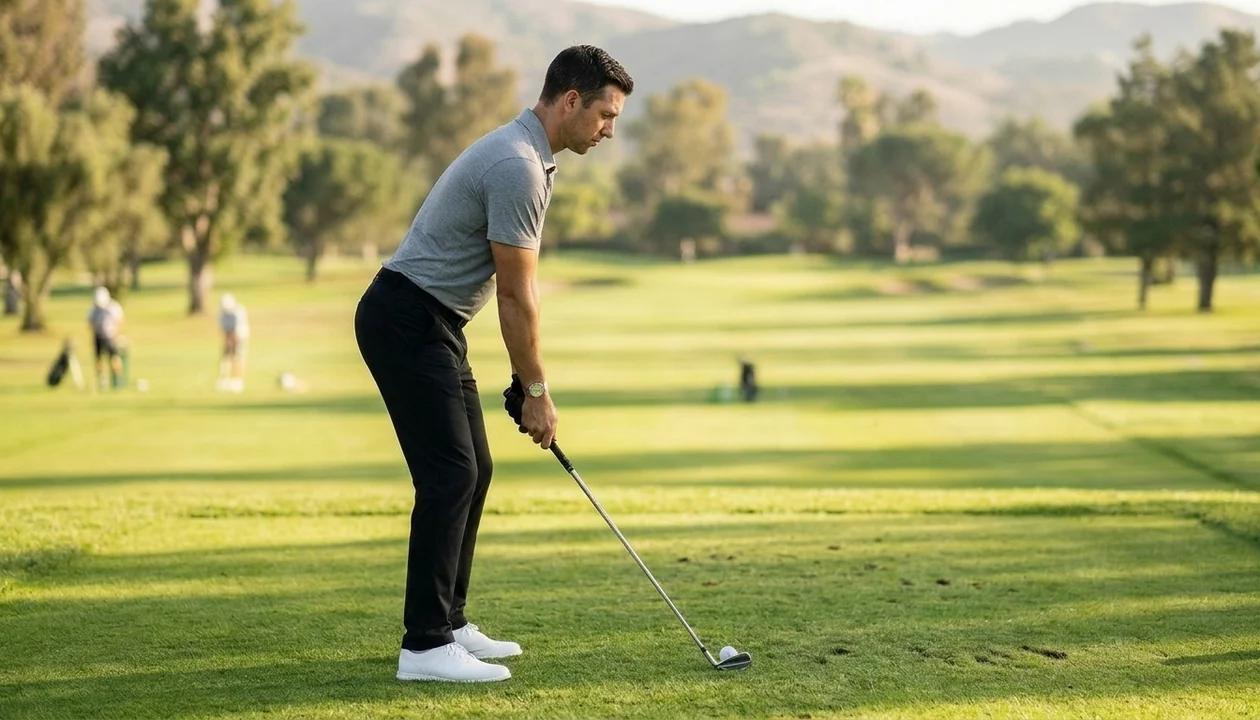
| A down-the-line phone photo at address catches posture faults instantly | Drawing a single straight line from your tailbone to the base of your neck reveals immediately whether your spine curves outward (C) or hollows inward (S). |
Quick answer
C-posture occurs when your upper back and shoulders slump into a rounded C-shape at address, blocking shoulder turn. S-posture occurs when you stick your tailbone out and over-arch your lower back, deactivating your core and triggering early extension. Fix both by hinging from your hip sockets with a braced pelvis and retracted shoulder blades.
Posture is the quietest swing killer in golf because it happens before the club ever moves. You can spend months grinding on downswing transition drills, yet if your spine is locked into a rounded C-posture or an arched S-posture at address, your ribcage and pelvis physically cannot rotate on an inclined plane.
According to Titleist Performance Institute (TPI) screening data, more than half of adult amateurs set up with either C-posture or S-posture. The good news is that address posture happens at zero miles per hour, which makes it the fastest mechanical fix in the game once you can see it on camera.
Neutral spine vs C-posture vs S-posture
Your thoracic spine (mid and upper back) is built to rotate, but only when the vertebrae are stacked in a neutral line. When you bend forward from your mid-back (C-posture) or hyperextend your lumbar spine (S-posture), the facet joints lock together and cut your rotational range of motion by 30 to 40 percent.
| Posture Profile | Spine & Pelvis Shape (DTL) | Primary Backswing Limitation | Typical Downswing Compensation |
|---|---|---|---|
| Neutral Athletic Posture | Flat spine from tailbone to neck; 35° to 40° hip hinge | Full 90°+ shoulder turn around stable spine | Maintains inclination angle through impact |
| C-Posture (Rounded Upper Back) | Convex C-curve across shoulders; chin tucked into chest | Thoracic spine locks; arms lift without body turn | Lifts out of posture or swings steep over the top |
| S-Posture (Arched Lower Back) | Excessive anterior pelvic tilt; hollow lumbar curve | Abdominals and glutes shut off during coil | Pelvis thrusts toward the ball (early extension) |
The 3-step hip-hinge routine for neutral address posture
- 1
Stand tall and hold the club shaft along your spine
Hold a golf club behind your back so the shaft touches three points at once: the back of your head, your upper thoracic spine between your shoulder blades, and your tailbone (sacrum).
- 2
Brace your glutes and ribs to remove lumbar arch
Before tilting forward, lightly engage your lower abs and glutes so the gap between your lower back and the club shaft shrinks to a finger's width. This eliminates S-posture before you bend.
- 3
Bow from your hip sockets while keeping all three contact points
Push your hips backward as if closing a car door with your glutes while keeping your head, mid-back, and tailbone touching the shaft. Soften your knees last until the clubhead reaches the turf.
Drills to fix C-posture and S-posture permanently
Posture and pelvic-tilt drills
Practice these four drills at home or on the range to replace C-posture and S-posture with a neutral athletic setup.

C Posture Drill - Primary Swing Fault
Fixes: C posture
Your The Coach

How To Fix S-Posture In Golf
Fixes: S posture
BreakThrough Physical Therapy, Wellness and Sports Performance

How to Stay In Posture | The Wall Drill
Fixes: C posture
Clay Ballard
Shaft Pull-Apart Shoulder Blades Posture Drill
Fixes: C posture
SwingStation
Related swing fault guides
See how setup posture connects to early extension and backswing width.
Frequently asked questions
What causes C-posture in the golf swing?
C-posture is usually caused by desk-bound tightness in the chest and upper back combined with bending from the upper waist instead of hinging from the hip sockets. Using clubs that are too short or standing too far from the ball also encourages upper-back slumping.
How does C-posture hurt my golf swing?
A rounded thoracic spine cannot rotate cleanly around a fixed axis. When you try to turn your shoulders in the backswing with C-posture, your head and chest are forced to lift up out of posture, causing thin tops, narrow backswing width, and over-the-top slices.
What is the difference between C-posture and S-posture in golf?
C-posture rounds the upper back into a convex C-shape from tailbone to neck, while S-posture over-arches the lower back into a concave hollow by tilting the pelvis too far forward. Both restrict rotation, and S-posture places high shear stress on the lumbar spine.
Sources
- Titleist Performance Institute (TPI) C-Posture and S-Posture Clinical Screen TPI kinematic research linking C-posture to loss of thoracic rotation and S-posture to early extension.
- Journal of Sports Sciences Lumbar Spine Loads in the Golf Swing Biomechanical analysis of anterior pelvic tilt and core muscle activation during the downswing.
How AI Golf School Diagnoses Your Swing
Instead of a vague list of swing tips, every analysis isolates your single root-cause fault, tracks 33 skeletal joints in 3D through impact, and pairs you with a focused drill plan.
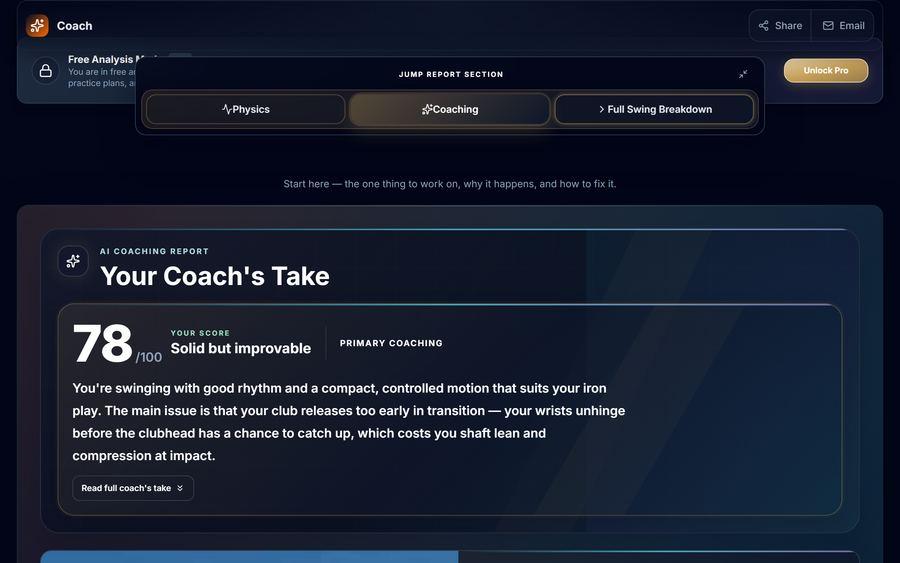
Composite score with root-cause flaw detection and severity ratings.
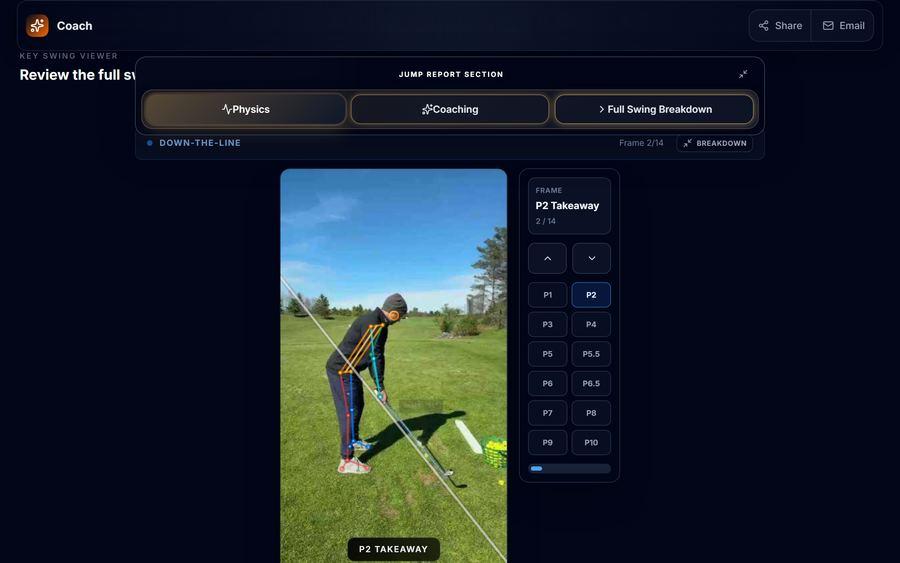
Swing Lens tracks 33 joints across all swing phases.
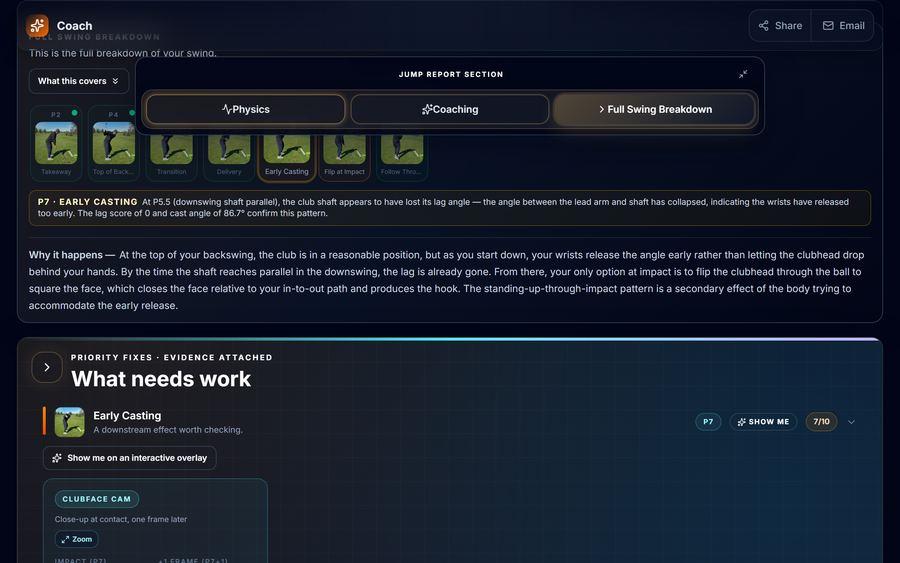
Personalized drills from certified coaches matched to your specific flaws.
Upload one video from your phone to diagnose your swing mechanics.