How to Fix a Flat Golf Swing Plane: Backswing Depth, Arm Lift, and Drills

Key takeaways
| Point | Details |
|---|---|
| A flat swing plane happens when horizontal arm pull outruns vertical wrist hinge | At the top of the backswing (P4), a flat lead arm sits below the shoulder plane, pinning the hands deep behind the trail heel. |
| Flat backswings create two opposite downswing compensations | Either the club stays trapped behind your hip (causing push-blocks and snap hooks) or your shoulders spin over the top to get the club back in front of you. |
| Fixing a flat swing starts at P2 and P3, not at the top | Keeping the clubhead outside your hands at P2 and setting your wrists upward by lead-arm parallel (P3) puts the shaft on plane automatically. |
| Check your lead arm against your shoulder line from down the line | At P4, your lead arm should roughly parallel your tilted shoulder line rather than cutting horizontally across your sternum. |
Quick answer
To fix a flat golf swing, stop whipping the clubhead inside your hands during the takeaway and add vertical wrist hinge before your lead arm reaches parallel to the ground (P3). When your chest turns around a stable spine tilt while your wrists set upward, your lead arm rises onto your shoulder plane at the top of the backswing.
Many golfers flatten their backswing on purpose because someone told them that swinging more around their body cures a slice. Unfortunately, sucking the club low and deep behind your heels during the backswing rarely produces a repeatable inside-out draw.
Instead, an overly flat backswing strands the mass of the clubhead behind your trail hip seam. From there, you are forced into a coin-flip downswing: either your arms stay trapped behind your rotating hips (producing a push-block or snap hook), or your upper body lunges outward over the top to rescue the club.
How to spot a flat swing plane at P2, P3, and P4
- 1
P2 (shaft parallel to the ground)
In a flat swing, the forearms roll clockwise immediately off the ball, pulling the clubhead 6 to 10 inches behind the hands and fanning the clubface open.
- 2
P3 (lead arm parallel to the ground)
Instead of pointing at or just inside the target line, the club shaft points well out to the right of the ball while the hands drift deep behind the trail thigh.
- 3
P4 (top of the backswing)
Viewed down the line, the lead arm cuts across the chest well below the shoulder line, and the hands sit behind the trail heel rather than stacked over the trail shoulder.
Interactive Face & Path Lab (Right-Handed)
Why a flat backswing causes both blocks and over-the-top slices
Push
- Club path:
- In to out
- measured from your swing
- Face at impact:
- Open to the target, square to the path
- worked out from where your ball started and how it curved
- Ball flight:
- Starts right, flies straight (little side spin)
- what you reported
Face Angle
+7.0°
~80% of start line
Club Path
+7.0°
In-to-out
Face to Path
0.0°
Face - Path = Curve
Start line: Starts well right (Face Angle +7.0°)
Curve: Stays straight right (Face matches path at 0.0°)
| Swing Position | Neutral On-Plane Backswing | Overly Flat Backswing | Resulting Downswing Fault |
|---|---|---|---|
| P2 Clubhead vs Hands | In line with hands or slightly outside | Whipped 6+ inches behind hands | Disconnects arms from chest early |
| P3 Shaft Extension Line | Points at target line or ball line | Points far outside the golf ball | Sets club laid-off or overly deep |
| P4 Lead Arm Plane | Matches tilted shoulder plane | Cuts low across sternum | Pins trail elbow behind hip seam |
| P6 Delivery Path | Clubhead tracks in line with hands | Either stuck inside or thrown outside | Two-way miss: push-hook or pull-slice |
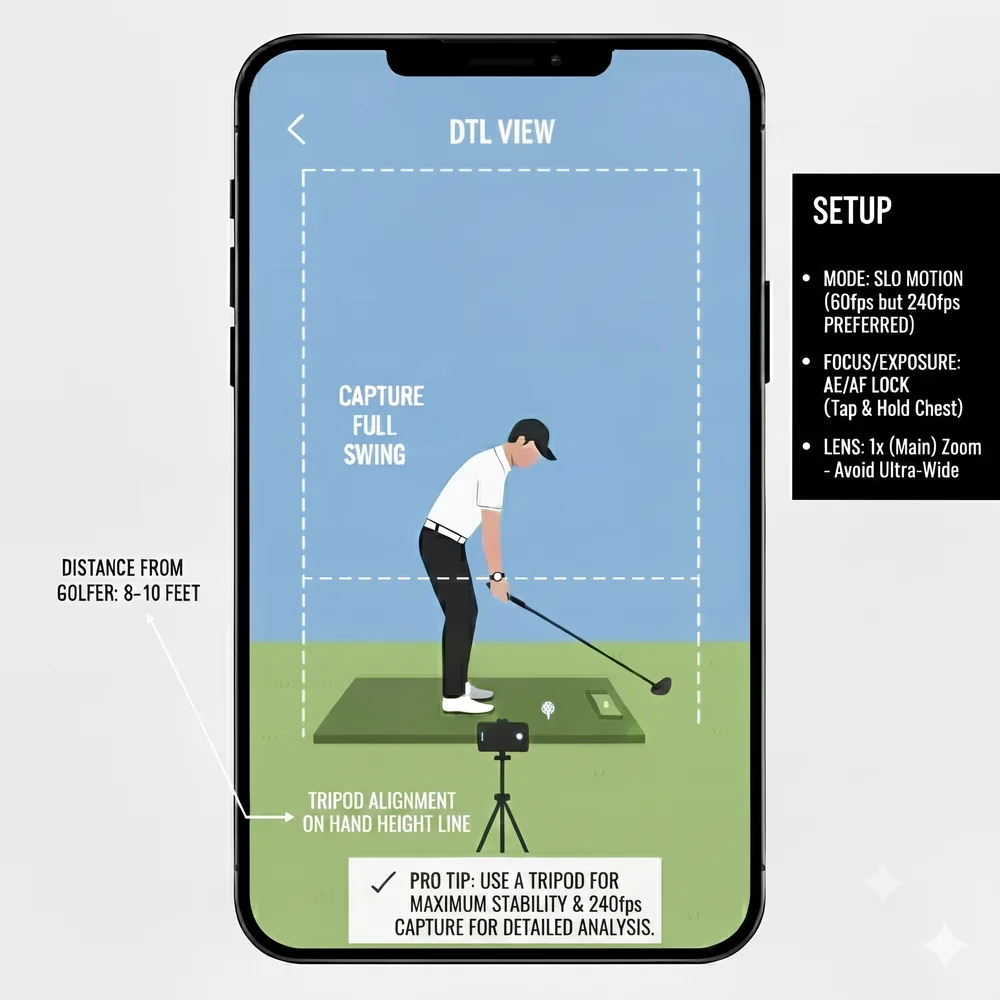
Drills to build an on-plane backswing
Plane and arm-depth drills
Use these four drills to keep the club in front of your chest and match your lead arm to your shoulder plane.

Hands In, Club Out Takeaway Station
Fixes: Outside takeaway
David Leathem Golf

Trail Arm Retraction (90-Degree Turn)
Fixes: Narrow Arc
Athletic Motion Golf

4-Step Across-the-Line Backswing Fix
Fixes: Across the line
Get Golfing

The Belt Loop Drill: Connected Sequence
Fixes: Getting stuck
Warren Bennett Golf Academy
Related swing fault guides
Dig deeper into the plane faults connected to a flat backswing.
Frequently asked questions
Is a flat golf swing bad?
A slightly flat swing can work if your body rotation and arm speed are perfectly matched, as seen in major champions like Matt Fitzpatrick. However, for most amateurs, an overly flat backswing traps the club behind the trail hip and requires last-second wrist timing or an over-the-top reroute to find the ball.
What misses does a flat golf swing cause?
If you drop the club down on the same flat plane, the path becomes excessively in-to-out (+6 to +9 degrees), producing blocks to the right and snap hooks to the left. If your upper body reacts by throwing the club outward from the top, you will hit high pull-slices.
How do I get my golf swing more upright without coming over the top?
Maintain your forward spine tilt from the hips at address, keep the clubhead outside your hands during the takeaway to P2, and hinge your lead thumb upward as your chest turns to P3. That sets the club on an upright plane on the way back while leaving room to shallow in transition.
Sources
- PGA Tour 3D Arm Depth and Shoulder Plane Benchmarks Down-the-line lead-arm angle relative to thoracic tilt at P3 and P4.
- Titleist Performance Institute (TPI) Swing Plane Mechanics How loss of spine tilt and early forearm roll flatten the backswing plane.
How AI Golf School Diagnoses Your Swing
Instead of a vague list of swing tips, every analysis isolates your single root-cause fault, tracks 33 skeletal joints in 3D through impact, and pairs you with a focused drill plan.
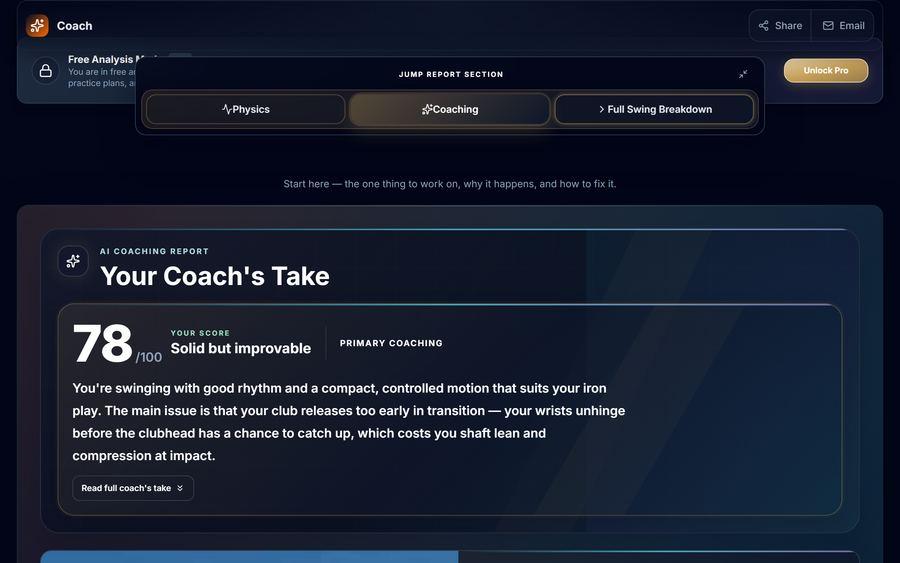
Composite score with root-cause flaw detection and severity ratings.
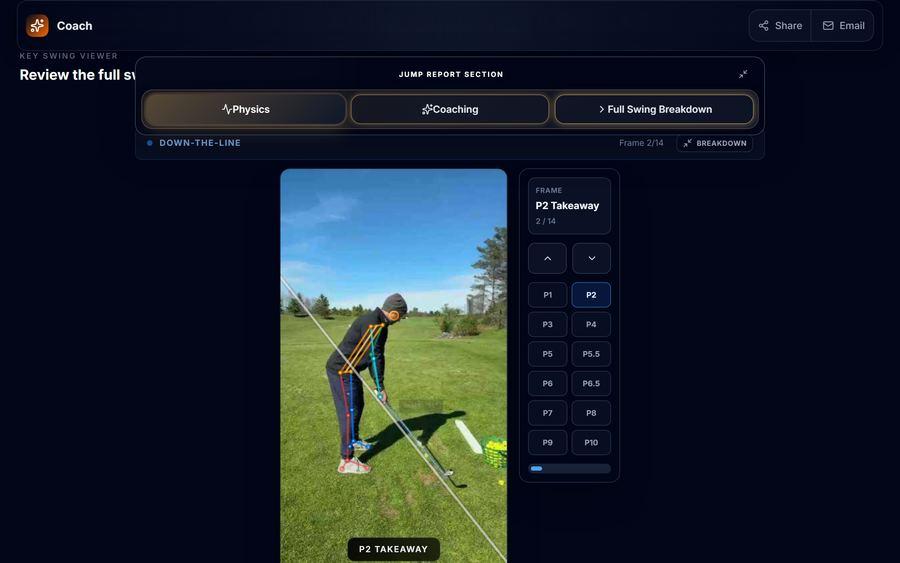
Swing Lens tracks 33 joints across all swing phases.
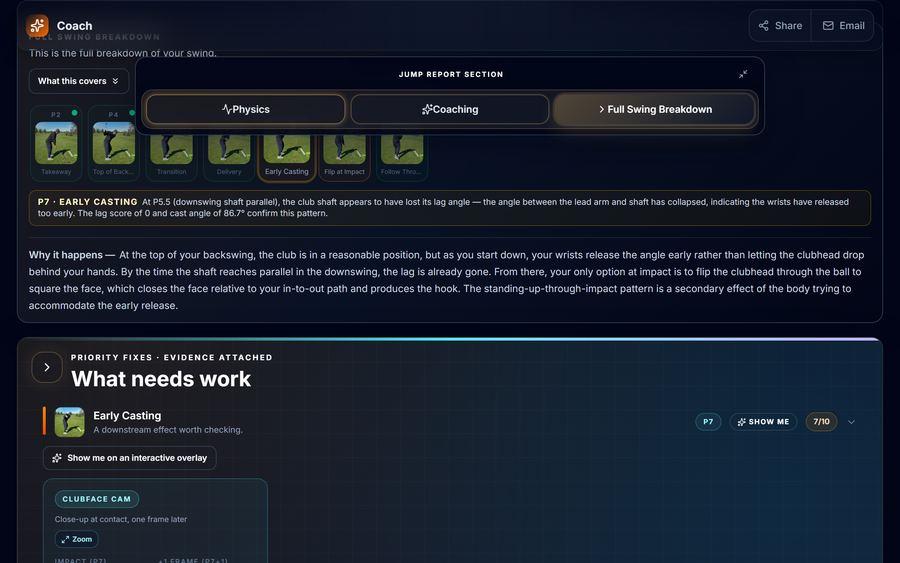
Personalized drills from certified coaches matched to your specific flaws.
Upload one video from your phone to diagnose your swing mechanics.