How to Fix a Laid-Off Golf Swing
By Paul Harris · Swing Kinematics Lead · Updated

⚡ Quick Answer & Diagnosis
Your swing is laid off when the shaft points left of the target at the top instead of parallel to the target line (for a right-hander). Before changing it, check what the club does in transition. If it steepens over the top or drops under, set the wrists up instead of rolling the club, keep the lead elbow down, and tilt the trail hand under the shaft.
| Biomechanical Root Cause | Corrective Action & Fix |
|---|---|
| The forearms roll the club open in the takeawayIf the first move away from the ball is a rotation of the forearms instead of a hinge of the wrists, the clubhead whips inside and the shaft lies down early. Stiff wrists that never set the club make it worse: as the shoulders keep turning, the club rolls further behind you until it points left of the target at the top. | Set the wrists up instead of rolling the clubUse GolfNow's Hinge-First Wrist Set Drill: from address, hinge the wrists until the shaft is parallel to the ground without turning the shoulders, then turn to complete the backswing. Hit shots this way, then blend it back into one motion. Porzak Golf's Vertical Wrist Set adds the cue: thumbs hinge up toward the sky early, without rolling the forearms, so the clubhead stays outside the hands. Greg Smith Golf Coach's Hinge and Twist is the same idea in two words. |
| A hands-and-arms takeaway that pulls the club insideWhen the hands start the backswing instead of the lead shoulder, they tend to drag the club too far inside in the first few feet. The arms then work around the body rather than in front of it, and the club arrives at the top behind you. | Start the takeaway with the lead shoulderGolf Distillery's Shoulder-Priority Takeaway moves the club straight back along the target line by turning the lead shoulder first, instead of letting the hands and arms manipulate the club early. At the top, check the trail elbow: close to the body at roughly 90 degrees, like a waiter carrying a tray. The elbow sits between two misses: let it ride up high and away and the club points across the line; keep it pinned so it never separates from your body and the club tends to lay off. |
| The lead elbow points out in front of youIn the backswing the lead elbow should point down toward the ground. When it points out toward the ball, the lead arm pulls the club around flat and behind your body, and the shaft ends up closer to parallel with the ground than it should be. | Keep the lead elbow pointing downGolfNow's Lead Elbow Down Drill: make slow backswings feeling the lead elbow point down toward the ground the whole way, not out in front of you. Check that the club stays closer to perpendicular with the ground than parallel to it, and pause at the top to confirm the elbow is still pointing down before you add speed. |
| A dead-flat trail palm under the shaft at the topMany golfers have been told to set the trail hand like a waiter holding a tray. Taken too literally, with the palm completely flat, that position can lay the shaft off. A small change in the tilt of that palm can move the shaft back toward the target line. | Tilt the tray at the topThe Art of Simple Golf's Waiter's Tray drill fixes the trail hand. At the top, feel the trail hand holding a tray of drinks at a slight angle, enough that something might slide off, rather than a traditional waiter's completely flat palm, which the coach calls too much. With the lead hand on top, feel a more rounded swing that stays in front of you. Hit 9-, 8- and 7-irons without trying to hit them hard, keeping your attention on the target and on extending through the ball. |
| A top position that feels on line but isn'tLaid off rarely feels laid off. After years of swinging to the same spot, that position feels normal, and without an outside reference you'll keep returning to it whatever feel you try. You need a check that tells you where the shaft actually points. | Check where the shaft points, then retestChris Ryan Golf's Swing Plane Alignment Stick Checkpoint Drill gives you the outside reference. Lay a stick on the ground on your target line just behind the ball and attach a straight pointer to the grip end of the club. When the lead arm reaches parallel, the pointer should point straight down at the stick; at the top, it should point back parallel to the target line, not laid off behind you. Exaggerate both extremes to find the middle by feel, then re-film and judge the change by the transition. |
Laid off describes where the shaft points at the top of the backswing. For a right-handed golfer, a club at parallel should point roughly down a line parallel to the target line. Laid off means it points left of the target, with the clubhead sitting behind your hands and the shaft flatter than your swing plane. Left-handers: reverse every direction in this guide.
Before you rebuild anything: a laid-off top is usually a contributor, not the root of your bad shots. Plenty of good players reach it and deliver the club fine. The damage happens in transition. Some golfers throw the club out over their hands to get it back on plane, which tends to bring pulls and slices. Others let it keep dropping under and get stuck, which tends to bring blocks and hooks. If neither happens and your ball flight is fine, the top isn't your problem.
So look at your transition, not just your top. A down-the-line swing video (or an AI swing analysis) shows where the shaft points and what the club does on the way down, which tells you whether laid off is costing you anything and which cause below is building it.
Why it happens
The forearms roll the club open in the takeaway
If the first move away from the ball is a rotation of the forearms instead of a hinge of the wrists, the clubhead whips inside and the shaft lies down early. Stiff wrists that never set the club make it worse: as the shoulders keep turning, the club rolls further behind you until it points left of the target at the top.
A hands-and-arms takeaway that pulls the club inside
When the hands start the backswing instead of the lead shoulder, they tend to drag the club too far inside in the first few feet. The arms then work around the body rather than in front of it, and the club arrives at the top behind you.
The lead elbow points out in front of you
In the backswing the lead elbow should point down toward the ground. When it points out toward the ball, the lead arm pulls the club around flat and behind your body, and the shaft ends up closer to parallel with the ground than it should be.
A dead-flat trail palm under the shaft at the top
Many golfers have been told to set the trail hand like a waiter holding a tray. Taken too literally, with the palm completely flat, that position can lay the shaft off. A small change in the tilt of that palm can move the shaft back toward the target line.
A top position that feels on line but isn't
Laid off rarely feels laid off. After years of swinging to the same spot, that position feels normal, and without an outside reference you'll keep returning to it whatever feel you try. You need a check that tells you where the shaft actually points.
How to fix it, step by step
- 1
Check the top and the transition before you change anything
Film from down the line and pause at the top: a shaft at parallel pointing left of the target is laid off. Then step through the downswing. If the club comes down on a sensible path and your shots start on line, leave the top alone. If it flips out over your hands (pulls, slices) or keeps dropping behind you (blocks, hooks), the top is worth working on.
- 2
Set the wrists up instead of rolling the club
Use GolfNow's Hinge-First Wrist Set Drill: from address, hinge the wrists until the shaft is parallel to the ground without turning the shoulders, then turn to complete the backswing. Hit shots this way, then blend it back into one motion. Porzak Golf's Vertical Wrist Set adds the cue: thumbs hinge up toward the sky early, without rolling the forearms, so the clubhead stays outside the hands. Greg Smith Golf Coach's Hinge and Twist is the same idea in two words.
- 3
Start the takeaway with the lead shoulder
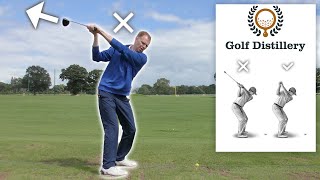
Golf Distillery's Shoulder-Priority Takeaway moves the club straight back along the target line by turning the lead shoulder first, instead of letting the hands and arms manipulate the club early. At the top, check the trail elbow: close to the body at roughly 90 degrees, like a waiter carrying a tray. The elbow sits between two misses: let it ride up high and away and the club points across the line; keep it pinned so it never separates from your body and the club tends to lay off.
- 4
Keep the lead elbow pointing down
GolfNow's Lead Elbow Down Drill: make slow backswings feeling the lead elbow point down toward the ground the whole way, not out in front of you. Check that the club stays closer to perpendicular with the ground than parallel to it, and pause at the top to confirm the elbow is still pointing down before you add speed.
- 5
Tilt the tray at the top
The Art of Simple Golf's Waiter's Tray drill fixes the trail hand. At the top, feel the trail hand holding a tray of drinks at a slight angle, enough that something might slide off, rather than a traditional waiter's completely flat palm, which the coach calls too much. With the lead hand on top, feel a more rounded swing that stays in front of you. Hit 9-, 8- and 7-irons without trying to hit them hard, keeping your attention on the target and on extending through the ball.
- 6
Check where the shaft points, then retest
Chris Ryan Golf's Swing Plane Alignment Stick Checkpoint Drill gives you the outside reference. Lay a stick on the ground on your target line just behind the ball and attach a straight pointer to the grip end of the club. When the lead arm reaches parallel, the pointer should point straight down at the stick; at the top, it should point back parallel to the target line, not laid off behind you. Exaggerate both extremes to find the middle by feel, then re-film and judge the change by the transition.
The best drills for this fault
Start with the first drill and move down the list if it doesn't fit your swing. Each drill page has step-by-step instructions and the coach's video.
 1
Fix Laid Off: The Waiter's Tray
by The Art of Simple Golf
 2
Shoulder-Priority Takeaway & Waiter's Elbow Checkpoint
by Golf Distillery
 3
Vertical Wrist Set (Anti-Flat)
by Porzak Golf
 4
Hinge-First Wrist Set Drill
by GolfNow
5Lead Elbow Down Drill (Anti-Laid-Off)
by GolfNow
 6
Swing Plane Alignment Stick Checkpoint Drill
by Chris Ryan Golf
 7
Fix Flat Backswing: Hinge and Twist
by Greg Smith Golf Coach
Training aids that help
Optional. Every drill above works with a club and an alignment stick - these just make the feedback harder to ignore.
Eyeline Golf Speed Trap
A base plate with 4 velcro rods. It creates a physical 'gate' that forces you to swing in-to-out. If you come Over-the-Top (Slice), you hit the soft rods.
View on AmazonWHYGOLF Alignment Discs & Padded Rods
Versatile setup and swing plane trainer with real-time feedback.
View on AmazonGolf Wrist Hinge Trainer
A wearable brace that clicks or restricts movement if you break your wrists too early. Excellent for curing the 'Flip' or 'Scoop' at impact.
View on AmazonAs an Amazon Associate we earn from qualifying purchases.
Frequently asked questions
Is a laid-off backswing a fault?
Not by itself. A laid-off top is one way to get to the ball, and plenty of solid ball strikers play from there. It becomes a problem when the transition has to make a large correction to get the club back on plane. Judge it by what happens next: if the club delivers on a good path and your shots start where you aim, there's nothing to fix.
How can I tell if I'm laid off?
Film from down the line and pause at the top. If you reach parallel, a right-hander's shaft should point roughly along a line parallel to the target line; pointing left of the target is laid off. Short of parallel it's harder to judge by eye, which is what the alignment stick checkpoint in the last step is for.
Why would a laid-off top make me pull or slice?
A laid-off shaft sits behind you and below the plane. A common reaction is to throw the club out over the hands at the start of the downswing, which steepens the shaft and sends the path out to in. That's one reason laid-off players often fight pulls and slices, though it isn't automatic.
Can being laid off cause hooks too?
Yes. If the club keeps dropping from the laid-off position instead of being thrown outward, it can get rerouted under the plane and approach from too far inside. That tends to produce blocks, pushes and hooks, the getting-stuck pattern. The same top can feed opposite misses, which is why the transition tells you what to fix.
What's the difference between laid off and a flat swing plane?
Laid off describes where the shaft points at the top. A flat swing plane describes the whole backswing: how the shoulders turn and where the arms and hands travel. A flat backswing often produces a laid-off shaft, but you can swing on a reasonable plane and still lay the club off through the wrists and trail hand, which is what most of the drills here target.
Going to the range to practice this drill?
Save your 1 Free AI Swing Analysis Credit now. We'll send your pass and our 2-minute camera setup checklist directly to your phone so you're ready when you step onto the mat.
Already have a swing video on this device? Analyze it now