Hands In, Club Out: How to Fix an Outside or Inside Golf Takeaway

Key takeaways
| Point | Details |
|---|---|
| Hands in, club out describes the geometry from address (P1) to shaft-parallel (P2) | As your chest rotates away from the ball, your hands trace a gentle arc inside the target line while the clubhead stays aligned with or slightly outside your hands. |
| An outside takeaway usually triggers a steep or laid-off compensation | Pushing the hands away from your thighs at P1 disconnects your arms from your torso and forces a mid-swing reroute at the top. |
| Whipping the clubhead inside at P2 causes an over-the-top loop | When forearms roll open early and suck the clubhead behind your heels, the only natural way down from the top is to throw the club steep over the plane. |
| At P2 the clubface leading edge should match your spine tilt | Check your down-the-line video when the shaft is parallel to the ground: a toe-up clubface is rolled open, while a leading edge tilted at roughly 45 degrees is square. |
Quick answer
A proper golf takeaway keeps the hands moving inward along your toe line while the clubhead stays on or just outside your hands until the shaft reaches parallel to the ground (P2). Achieve this by rotating your ribcage as one connected unit with your arms rather than lifting the club with your hands or rolling your wrists.
Nothing happens in the downswing in isolation. When a golfer fights an over-the-top slice or gets stuck underneath the plane, the root cause frequently shows up in the very first 18 inches of the backswing. If the club leaves the ground out of position between setup (P1) and shaft-parallel (P2), the rest of the swing becomes a chain of compensations.
Coaches summarize the ideal tour takeaway in four words: hands in, club out. Because the golf club rests on an inclined plane while your feet stand inside the ball, your hands and the clubhead should not travel on the exact same straight line away from the target.
The P2 down-the-line checkpoint explained
When you record your golf swing from down the line with the camera lens at hand height, scrub the video to position P2: the exact frame where the club shaft is parallel to the ground on the way back. Three visual markers tell you immediately whether your takeaway is on plane.
- 1
Hand path stays on your toe line
As your chest turns away from the target, your hands move slightly inward so they remain directly over your shoelaces rather than pushing out toward the golf ball.
- 2
Clubhead hides the hands or sits just outside them
At P2, the clubhead should sit directly in line with your hands or an inch toward the ball side of your hands, with the shaft pointing parallel to your target line.
- 3
Leading edge matches your spine angle
Look at the leading edge of the clubface at P2. It should tilt forward at roughly 40 to 45 degrees, matching your upper spine tilt. If the toe points straight at the sky, you have rolled your forearms open.
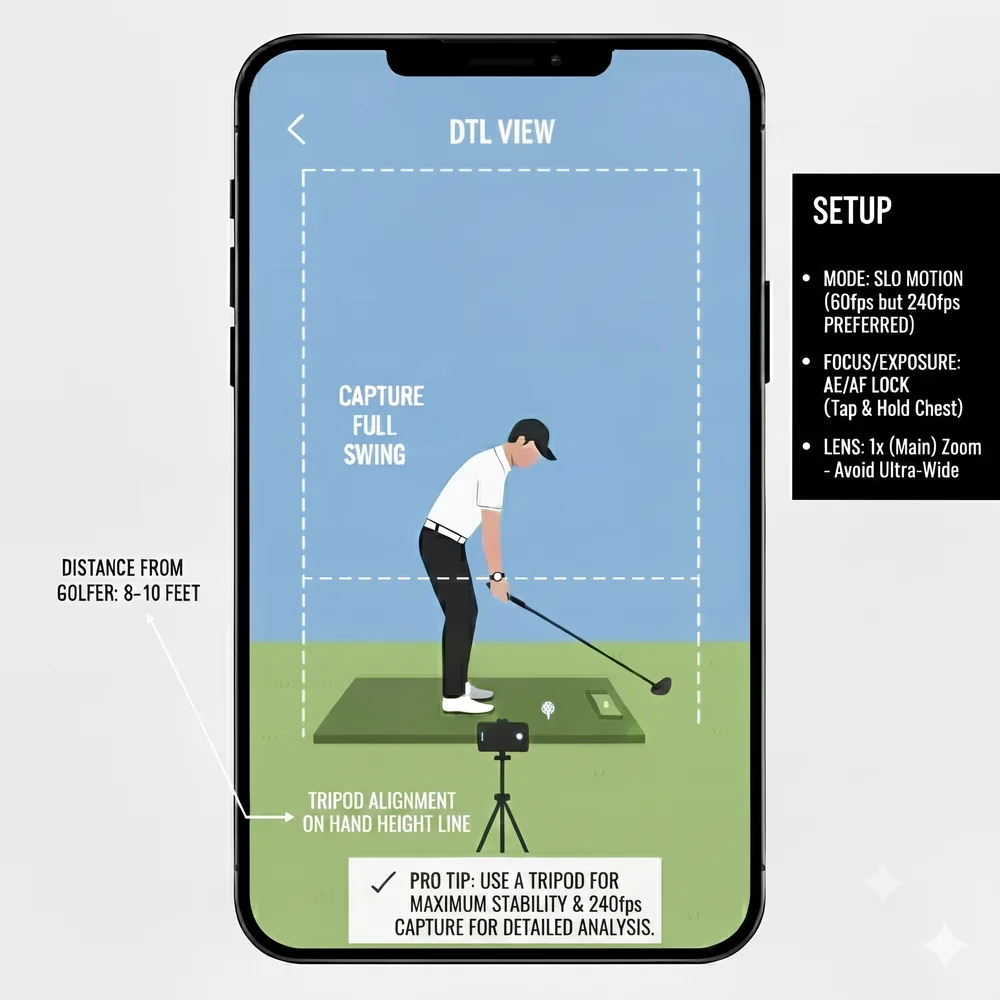
| Checkpoint at P2 | Tour Hands In / Club Out | Inside Whip Takeaway | Disconnected Outside Takeaway |
|---|---|---|---|
| Clubhead Position (DTL) | Covers hands or 1 inch outside | Behind heels (6+ inches inside) | Outside the ball line |
| Hand Path at P2 | Arcs gently inward over toes | Pulled deep behind trail thigh | Pushed outward away from body |
| Clubface Leading Edge | Matches spine tilt (square) | Toe pointing straight up (open) | Shut or hooded toward turf |
| Downswing Consequence | On-plane transition slot | Over-the-top loop at P4 | Narrow arc or across-the-line top |
How a bad takeaway ruins your impact path
Your brain is wired to balance the club's center of mass. When you whip the clubhead inside your hands during the takeaway, the weight of the club gets stranded behind your body. At the top of the swing, your nervous system senses that the club is too flat and deep, so it fires your shoulders outward to bring the club back in front of you, producing an out-to-in slice path.
Interactive Face & Path Lab (Right-Handed)
See how takeaway errors show up in your impact path
Straight
- Club path:
- Along the target line
- measured from your swing
- Face at impact:
- Square to the target, square to the path
- worked out from where your ball started and how it curved
- Ball flight:
- Starts straight, flies straight (little side spin)
- what you reported
Face Angle
0.0°
~80% of start line
Club Path
0.0°
Neutral
Face to Path
0.0°
Face - Path = Curve
Start line: Starts on target (Face Angle 0.0°)
Curve: No curve (Face to Path 0.0°)
Drills to groove a hands-in, club-out takeaway
Station and connection takeaway drills
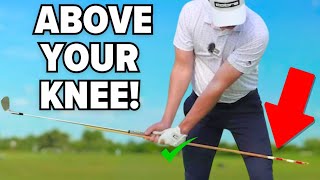
Use these four drills to stop rolling your wrists and lock in the hands-in, club-out feel at P2.



Related swing fault guides
Read our full technical guides on takeaway mechanics and backswing width.
Frequently asked questions
What does hands in, club out mean in the golf takeaway?
It means that during the first three feet of the backswing, your hands move inward along your toe line with your turning torso while the clubhead stays on the target side (outside) of your hands when viewed down the line.
How do I know if my golf takeaway is too far outside?
Film your swing from directly behind your hands down the target line and pause at position P2 (when the shaft is parallel to the turf). If your hands have drifted out toward the ball line and the clubhead sits far outside the ball, your takeaway is disconnected and outside.
Why does rolling my wrists in the takeaway cause a slice?
Rolling your forearms clockwise during the takeaway fans the clubface wide open and pulls the clubhead flat behind your back. From that trapped position at the top, your upper body spins out first to get the club back to the ball, producing an out-to-in slice.
Sources
- PGA Tour P2 Takeaway Geometry and Shaft Plane Studies Down-the-line P2 shaft and clubface checkpoints across tour players.
- Titleist Performance Institute (TPI) One-Piece Takeaway Kinematics Thoracic rotation versus independent arm lift during the first 24 inches of the backswing.
How AI Golf School Diagnoses Your Swing
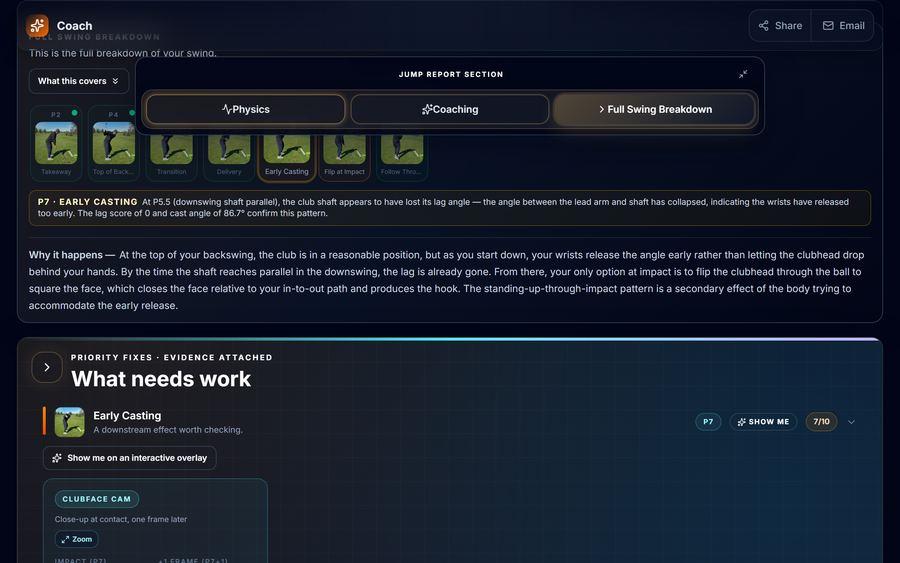
Instead of a vague list of swing tips, every analysis isolates your single root-cause fault, tracks 33 skeletal joints in 3D through impact, and pairs you with a focused drill plan.
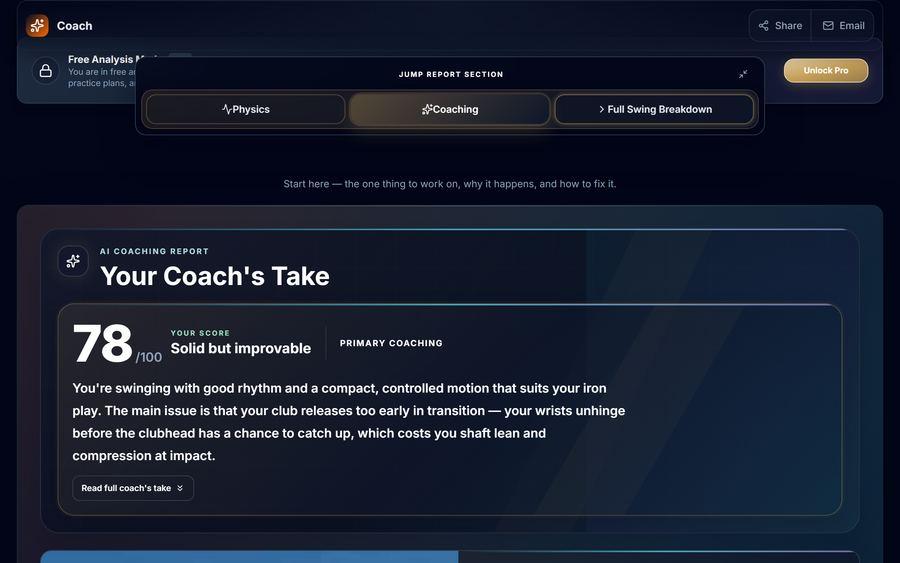
Composite score with root-cause flaw detection and severity ratings.
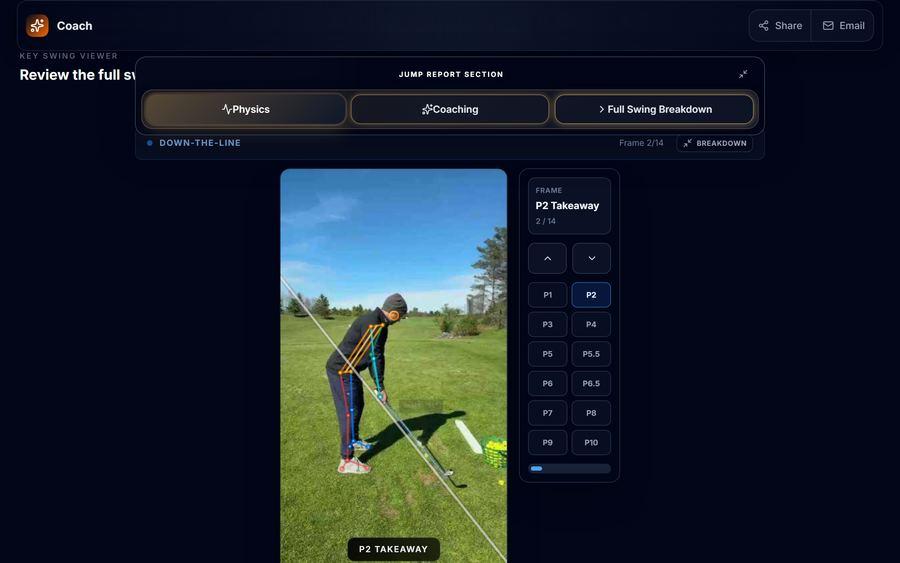
Swing Lens tracks 33 joints across all swing phases.
Personalized drills from certified coaches matched to your specific flaws.
Upload one video from your phone to diagnose your swing mechanics.