How to Stop Slicing Your Driver: Clubface Control, Path, and Setup Fixes

Key takeaways
| Point | Details |
|---|---|
| The clubface controls 80 percent of initial launch direction | A driver slice curves right because the clubface is open relative to the club path at impact, tilting the spin axis clockwise for a right-handed golfer. |
| Aiming further left makes a driver slice worse | Opening your stance to compensate for a slice forces the club onto a steeper out-to-in path, widening the face-to-path gap and adding more slice spin. |
| Fix the clubface first, then shallow the delivery path | Neutralizing a weak grip and removing lead-wrist cupping at the top of the backswing closes the face so you can swing from the inside without blocking the ball right. |
| Driver setup requires rearward spine tilt behind the ball | Setting your sternum 2 to 3 inches behind the golf ball with 8 to 10 degrees of rightward spine tilt promotes an upward, inside-out strike. |
Quick answer
To stop slicing your driver, square the clubface before trying to swing more from the inside. Strengthen your lead-hand grip so you see two to three knuckles at address, tilt your upper spine slightly away from the target behind the ball, and let your arms drop down before firing your shoulders at the top of the downswing.
The driver slice is the single biggest distance killer in amateur golf. Even when you make solid center-face contact, a glancing blow with an open face converts forward ball speed into high, floating sidespin that robs 25 to 40 yards of carry and finds the right rough.
Most golfers try to cure a slice on the range by aiming further left or trying to swing harder down the target line. Both moves backfire. Under D-plane physics, aiming your body left shifts your swing path further out-to-in, which increases the angle between your clubface and your path and makes the ball curve even harder to the right.
The face-to-path physics behind every driver slice
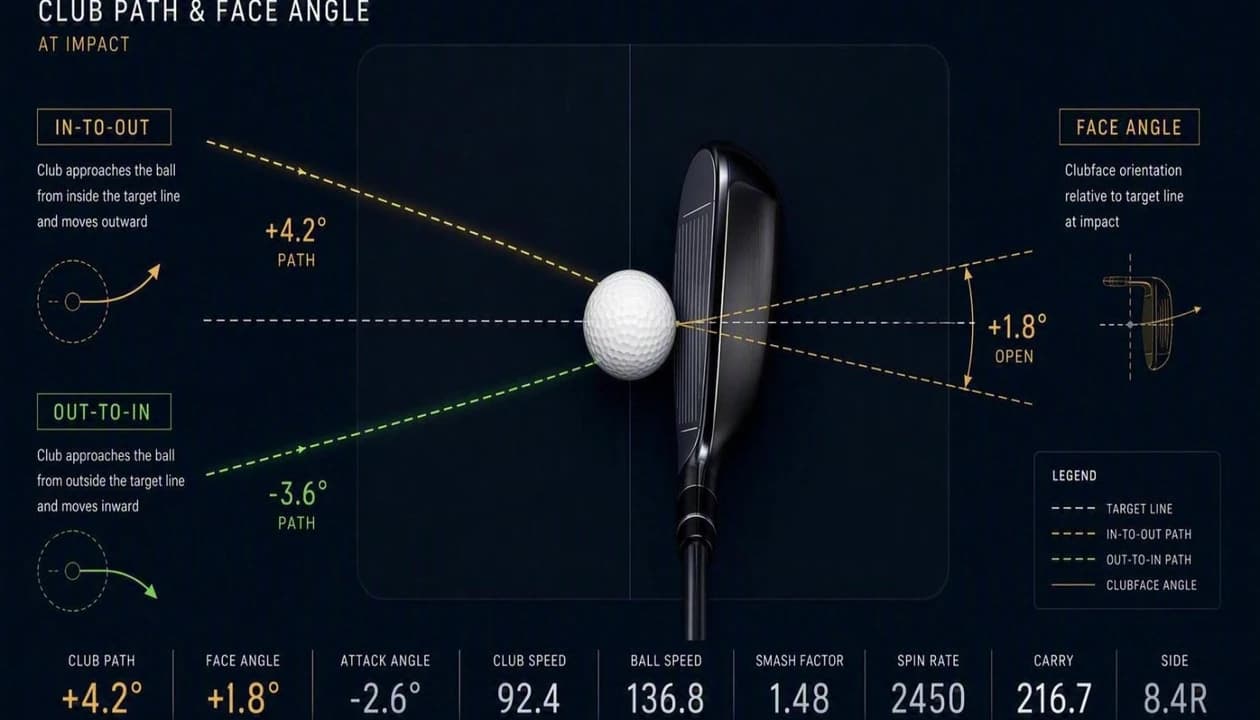
Your golf ball only cares about two things at the millisecond of separation: where the clubface points (face angle) and the direction the clubhead is traveling (club path). With a driver, the clubface sets roughly 85 percent of the ball's initial starting line, while the difference between face angle and club path tilts the spin axis.
Interactive Face & Path Lab (Right-Handed)
Compare a driver slice against a neutral path and tour draw
Pull slice
- Club path:
- Out to in
- measured from your swing
- Face at impact:
- Closed to the target, open to the path
- worked out from where your ball started and how it curved
- Ball flight:
- Starts left, curves right (slice spin)
- what you reported
Face Angle
-1.0°
~80% of start line
Club Path
-6.0°
Out-to-in
Face to Path
+5.0°
Face - Path = Curve
Start line: Starts slightly left (Face Angle -1.0°)
Curve: Slices hard right (Face is +5.0° open to path)
- Pull-slice (most common): The club travels out-to-in (-6 degrees) while the face points left of the target (-2 degrees) but remains 4 degrees open to the path. The ball starts left and slices across the fairway.
- Push-slice: The club travels neutral or slightly inside-out (+2 degrees), but the clubface arrives wide open (+6 degrees). The ball starts right and curves further right into trouble.
- Straight-pull: The golfer finally squares the clubface to the out-to-in path (-5 degrees face, -5 degrees path). The slice spin disappears, but the ball flies dead left into the trees.
| Impact Parameter | Tour Driver Draw | Amateur Driver Slice | Effect on Ball Flight |
|---|---|---|---|
| Club Path | +2.0° to +4.0° (in-to-out) | -4.0° to -8.0° (out-to-in) | Out-to-in swipe cuts across the ball equator |
| Face-to-Path Angle | -1.0° to -2.5° (closed to path) | +4.0° to +8.0° (open to path) | Open face-to-path tilts spin axis 15° to 30° right |
| Angle of Attack | +2.0° to +4.0° (hitting up) | -2.0° to -5.0° (hitting down) | Steep downward strike adds 800+ RPM backspin |
| Lead Wrist at P6 | Flat to slightly bowed (flexed) | Cupped (extended 10° to 20°) | Cupped lead wrist leaves the clubface lagging open |
Step-by-step fix: setup, wrist angle, and inside delivery
If you try to swing from the inside while your clubface is still wide open, your brain will sense that the ball is headed 40 yards right and force you to come over the top at the last second. Follow this sequence in order so your body feels safe swinging from the inside.
- 1
Check your grip strength before taking the club back
Place your lead hand on the club so the V formed by your thumb and index finger points toward your trail shoulder, showing two to three knuckles when you look down. See our full strong vs weak golf grip guide to verify your hand placement.
- 2
Set the ball off your lead heel with rearward spine tilt
Move the ball forward in your stance opposite your lead heel, then bump your hips 2 inches toward the target so your shoulders tilt upward. This positions your sternum behind the ball and naturally shifts your swing path outward as the club rises after low point.
- 3
Flatten your lead wrist at the top of the backswing (P4)
A cupped lead wrist opens the clubface. As you transition into the downswing, feel the logo of your golf glove turn toward the ground (bowing or flattening the wrist) so the clubface squares up by waist height (P6).
- 4
Keep your back to the target for an extra beat in transition
Instead of spinning your trail shoulder out toward the ball, let your hands drop toward your trail pocket while your chest stays closed for a fraction of a second. This drops the driver head inside the target line so you can release the club out toward right-center field.
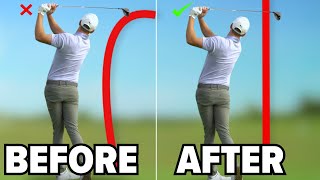
Range drills to cure a driver slice
Targeted slice-correction drills
Work through these four drills on the range to square the face and train an inside-out driver path.



Related swing fault guides
Explore our complete biomechanical breakdowns for each piece of the slice pattern.
Frequently asked questions
Why do I slice my driver when I hit my irons straight?
The driver has the lowest loft in your bag (typically 9 to 10.5 degrees) and the longest shaft. Low backspin means any sidespin tilts the spin axis dramatically, and the longer arc gives an open clubface more time to lag behind your body rotation.
Does a weak golf grip cause a driver slice?
Yes. When your lead hand sits rotated too far to the left on the handle (showing only one knuckle at address), the clubface naturally opens during the backswing and requires a timed wrist flip at impact to square up.
Should I close my stance to stop slicing my driver?
Dropping your trail foot back 1 to 2 inches at address is a helpful drill feel because it presets your pelvis and shoulders slightly closed to the target line, encouraging the clubhead to travel from inside to out through the ball.
How fast can AI swing analysis spot the cause of my slice?
A single down-the-line phone video uploaded to AI Golf School isolates whether your slice starts from a weak setup, an open clubface at P6, or an over-the-top shoulder spin at P4 in under two minutes.
Sources
- TrackMan Ball Flight Laws and Face-to-Path Ratio D-plane measurements showing face angle accounts for roughly 85 percent of driver start direction.
- Titleist Performance Institute (TPI) Driver Setup Kinematics 3D motion capture benchmarks for spine tilt and pelvis alignment with the driver.
How AI Golf School Diagnoses Your Swing
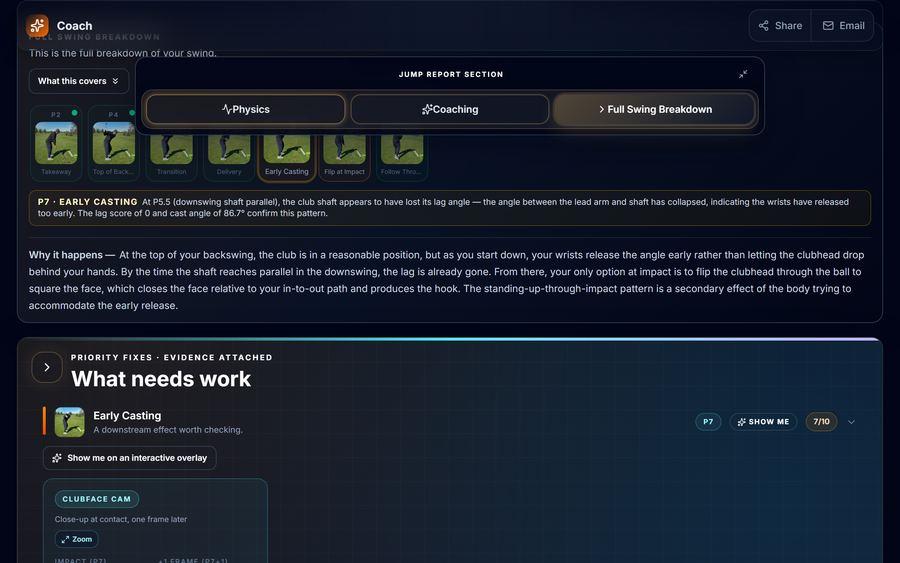
Instead of a vague list of swing tips, every analysis isolates your single root-cause fault, tracks 33 skeletal joints in 3D through impact, and pairs you with a focused drill plan.
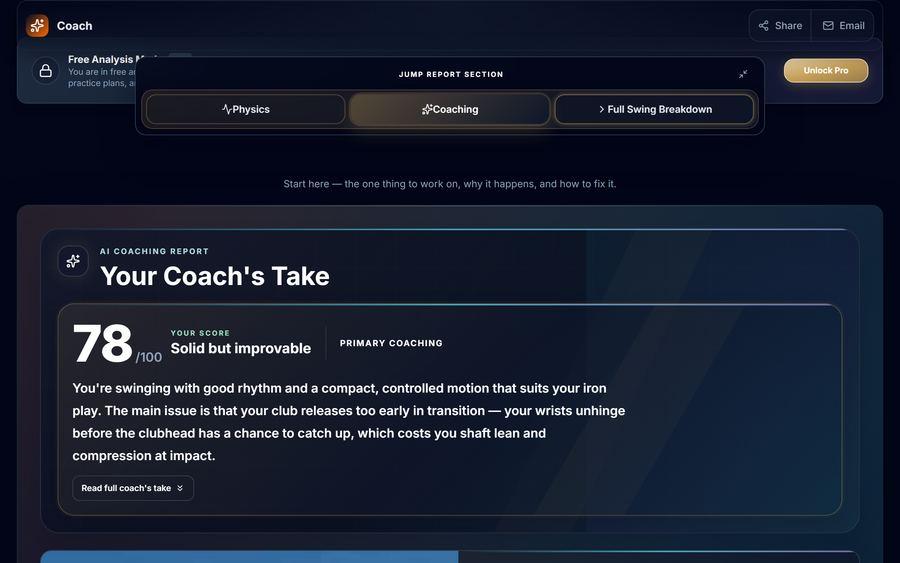
Composite score with root-cause flaw detection and severity ratings.
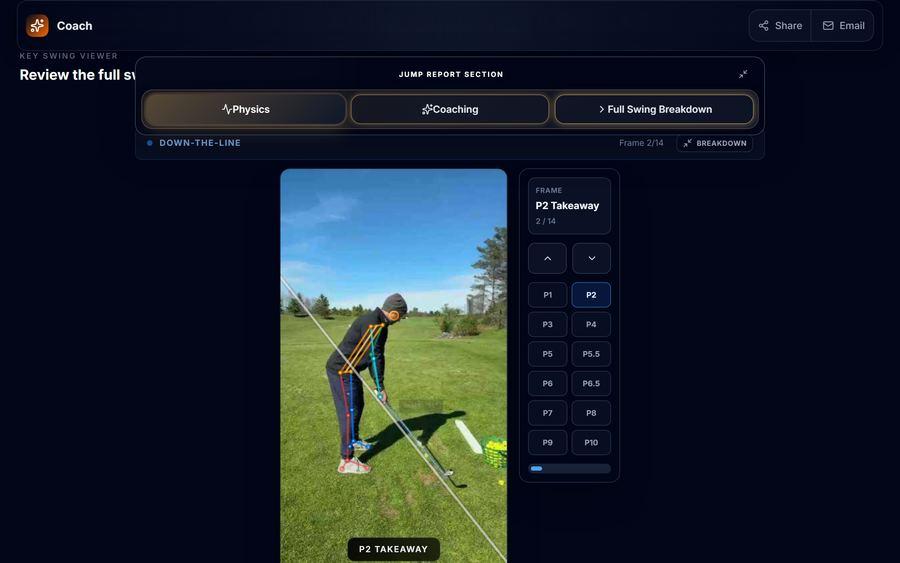
Swing Lens tracks 33 joints across all swing phases.
Personalized drills from certified coaches matched to your specific flaws.
Upload one video from your phone to diagnose your swing mechanics.