How to Stay Connected in the Golf Swing

⚡ Quick Answer & Diagnosis
Connection means the arms stay in front of the chest so the body powers the club rather than the hands. You lose it when the arms lift independently in the takeaway, when the trail elbow flies out at the top, or when the body stalls through impact and the arms have to take over. Fix it by making the chest start and finish the swing, using a headcover or towel under the arm as feedback rather than trying to hold the arms in place by feel.
Connection is one of those words that gets used constantly and defined rarely. In practice it means one thing: your arms and your torso move as a single unit, so the club is driven by the biggest muscles you have rather than steered by the smallest.
When connection goes, the symptoms rarely announce themselves as a connection problem. You see a narrow, armsy backswing. You see the trail elbow flying at the top. You see a chicken wing through impact and strikes scattered across the face. Each of those gets treated as its own fault, which is why golfers can spend a season fixing four different things that were all the same thing.
The reason connection is worth attacking directly is that it is upstream of all of them. An AI swing analysis is useful here precisely because it can show you WHERE the arms separate: the takeaway, the top, or impact, and each of those has a different fix.
Why it happens
The arms lift independently in the takeaway
The first move away is the easiest place to lose connection, because at address the arms can move without the body noticing. If the hands travel up while the chest stays still, the arms are already working on their own path before the swing has properly started, and every position after that is a recovery.
The trail elbow separates at the top
A trail elbow that drifts behind the body rather than folding in front of it puts the club in a position the torso cannot deliver. From there the only way down is with the arms, which is what makes an over-the-top or stuck downswing feel unavoidable rather than optional.
The body stalls through impact
This is connection lost at the last possible moment. If the chest stops turning at the ball, the arms carry all of the club momentum and the lead elbow buckles to absorb it. Extension through impact is a byproduct of a body that keeps rotating, so a stall shows up as a chicken wing no amount of arm-straightening will fix.
Over-gripping the club
Tension in the hands and forearms travels up into the shoulders and locks the arms to a position rather than to the body. Connected arms are soft arms. A grip pressure that feels almost too light is usually the right one.
How to fix it, step by step
- 1
Find out where you lose it before you fix anything
Takeaway, top, and impact are three different faults wearing the same name, and the drill for one will not help the others. Film a swing down the line and watch the gap between your trail arm and your torso at those three moments.
- 2
Use an object, not a feeling
A headcover under the trail armpit tells you the instant you disconnect and exactly where in the swing it happened. Trying to hold the arms connected by feel usually produces a squeezed, short swing that is worse than the original problem.
- 3
Start the swing with the chest
If the first move is the chest turning rather than the hands lifting, the arms have no opportunity to get ahead of the body. Rehearse just the first two feet of the takeaway until the club moves because the torso moved.
- 4
Keep turning through the ball
Connection at impact is a rotation problem. Practise stopping at a waist-high follow-through with the lead arm still across the chest, then build back to full speed keeping that checkpoint.
- 5
Add speed last
Connection holds at half speed long before it holds at full speed. Move up in thirds and drop back a level the moment the feedback object falls out.
The best drills for this fault
Ranked by effectiveness. Each drill page includes step-by-step instructions and a video demonstration.
Trail-Armpit Headcover (Width Without Disconnection)
Chest-Turn Release Through Impact
 3
3Double-Armpit Towel Core Synchronization
by Athletic Motion Golf
 4
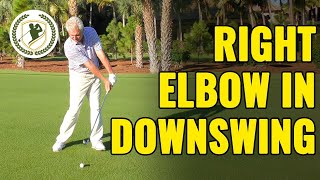
4Right Elbow In Golf Downswing Drills (PERFECT POSITION!)
by Adam Bazalgette
 5
5Collin Morikawa explains how to keep your hands and body in sync
by Collin Morikawa (PGA TOUR)
 6
6Dr. Kwon's Connection & Rhythm Drill
by Dr. Kwon (via Chris Como Golf)
7Arm Sync Drill
by PGA
 8
8The Match-Up Drill (Torso/Hip Sync)
by Me and My Golf
 9
9One Piece Takeaway Drill
by Kerrod Gray
Training aids that help
Optional. Every drill above works with a club and an alignment stick - these just make the feedback harder to ignore.
Orange Whip Trainer
The premier counter-weighted flexible trainer. The counter-weight helps you feel the clubhead throughout the swing, promoting perfect rhythm and balance.
View on AmazonSKLZ Gold Flex Trainer
A heavy, flexible whippy shaft. It forces you to wait for the clubhead in transition, smoothing out jerky tempos and stretching golf-specific muscles.
View on AmazonTour Striker Smart Ball (Connection)
An inflatable lanyard ball held between the forearms. It physically prevents the 'Chicken Wing' and forces the arms and torso to rotate together as a connected unit.
View on AmazonAs an Amazon Associate we earn from qualifying purchases.
Frequently asked questions
Should I practise with a towel under both arms or just one?
One is usually better. A towel under both arms enforces connection but also shortens your arc, and golfers who practise it heavily can end up with a cramped, all-body swing that loses width. A single headcover under the trail arm keeps the trail elbow in front of the body without restricting the lead arm.
Can you be too connected?
Yes. Connection is not the arms being pinned to the chest, it is the arms and body moving in the same sequence. A swing with no independent arm movement at all tends to be short, flat and low on speed. The goal is synchronisation, not restriction.
Is a chicken wing a connection problem?
Almost always, but at the last moment rather than the first. The lead elbow folds through impact because the body stopped rotating and the arms had nowhere to go. That is why straightening the arm on purpose rarely works: the arm is compensating for something upstream.
How long does it take to fix?
Connection responds faster than most swing changes because the feedback is immediate and physical, but it is speed-dependent. Most golfers hold it at half speed within a session or two and lose it again at full speed for several weeks. Progress means holding it a rung higher, not holding it perfectly.