Golf Swing Tempo Drills: Mastering the 3:1 Ratio for Consistent Strikes

Key takeaways
| Point | Details |
|---|---|
| Tempo is a ratio, not a speed | You can have a quick or slow swing as long as your backswing takes three times longer than your downswing. |
| Rushing transition ruins clubface control | Allowing the transition to breathe gives the clubhead time to drop into the slot on a shallow plane. |
Quick answer
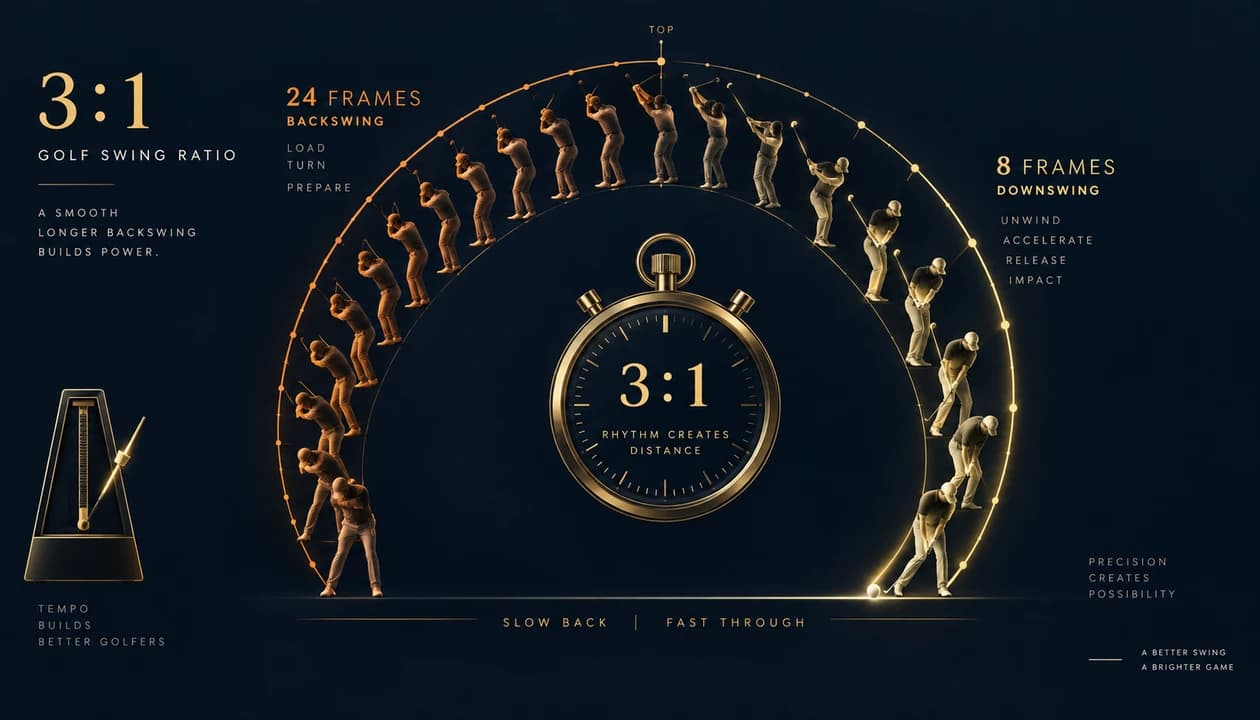
Golf swing tempo is the elapsed time ratio between the backswing and downswing. Biomechanical research shows that elite players consistently exhibit a 3:1 tempo ratio: the backswing takes exactly three times as long as the downswing to impact. Rushing the takeaway or lunging into transition destroys this ratio, causing timing breakdowns and erratic strikes.
Golfers often confuse tempo with swing speed. Ernie Els and Nick Price swung with completely different rhythms: Els was buttery and relaxed, Price was quick and energetic. Yet high-speed motion analysis revealed that both golfers had identical 3:1 tempo ratios. Their internal clock was scaled differently, but the mathematical relationship between backswing and downswing was identical.
Why the 3:1 ratio creates repeatable impact
The backswing is the loading phase where potential energy is stored in muscular stretch and clubhead elevation. If your backswing is too quick, your muscles cannot complete their stretch cycle, causing transition to stutter. If your backswing is too slow and dragging, momentum dies, forcing you to snatch at the ball from the top.
Tour player tempo benchmarks by frames (at 30 fps)
| Player Profile | Backswing Frames | Downswing Frames | Tempo Ratio |
|---|---|---|---|
| Fast Tempo (e.g. Nick Price, Viktor Hovland) | 21 frames (0.70s) | 7 frames (0.23s) | 3.0 : 1 |
| Medium Tempo (e.g. Tiger Woods, Rory McIlroy) | 24 frames (0.80s) | 8 frames (0.27s) | 3.0 : 1 |
| Deliberate Tempo (e.g. Ernie Els, Collin Morikawa) | 27 frames (0.90s) | 9 frames (0.30s) | 3.0 : 1 |
| Common Amateur Error | 16 frames (rushed) or 36 frames (dragging) | 10 frames (decelerating) | 1.6 : 1 or erratic |
Rhythm drills to lock in your 3:1 timing
Practice these tempo-focused drills with a metronome or auditory cues to develop consistent rhythm.


Related swing rhythm guides
Frequently asked questions
How do I measure my tempo ratio at home?
Upload your swing video to AI Golf School. The Oracle physics engine automatically timestamps P1, P4, and P7, calculating your exact backswing, downswing, and tempo ratio in seconds.
Should my driver and wedge tempo be the same?
Yes. Tour players maintain a 3:1 tempo ratio across every club in the bag, from driver down to full pitching wedges.
How AI Golf School Diagnoses Your Swing
Instead of a vague list of swing tips, every analysis isolates your single root-cause fault, tracks 33 skeletal joints in 3D through impact, and pairs you with a focused drill plan.
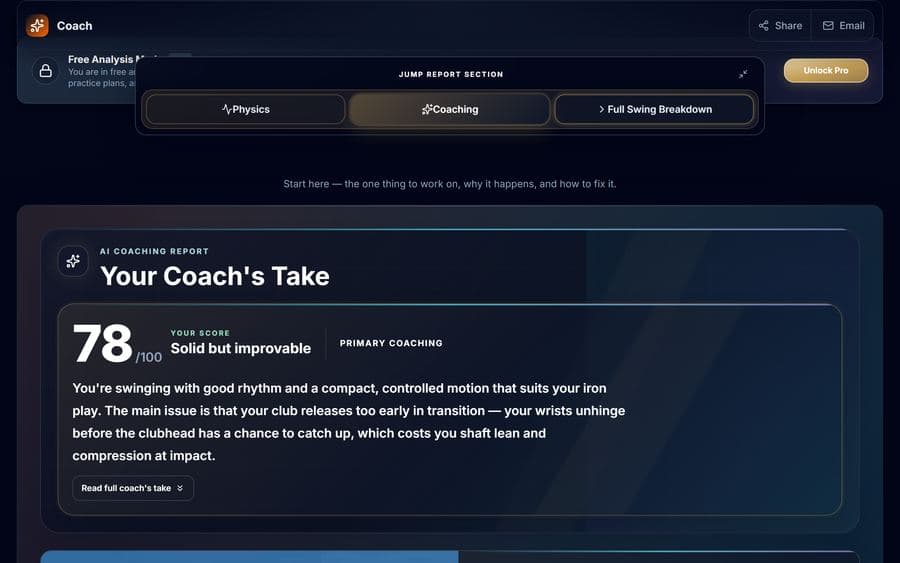
Composite score with root-cause flaw detection and severity ratings.
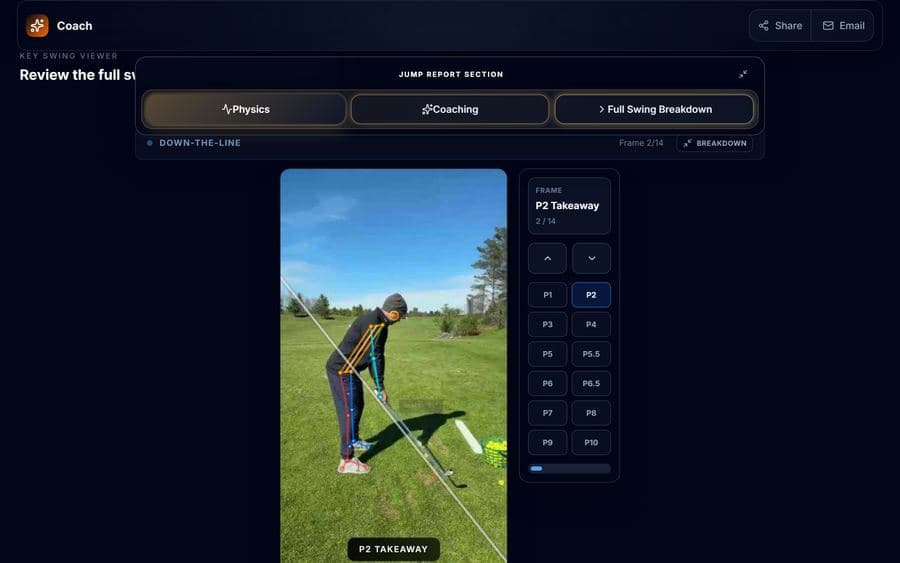
Swing Lens tracks 33 joints across all swing phases.

Personalized drills from certified coaches matched to your specific flaws.
Upload one video from your phone to diagnose your swing mechanics.