How to Stop Flipping at Impact: Restoring Forward Shaft Lean

Key takeaways
| Point | Details |
|---|---|
| Flipping is scooping the ball with the wrists | The clubhead passes the hands before impact, adding loft and moving the swing low point behind the ball. |
| Tour pros strike irons with 8 to 12 degrees of shaft lean | Hands lead the clubhead into the strike, de-lofting the club and compressing the ball against the turf. |
| Flipping is almost always caused by stalled body turn | When the hips and chest stop rotating through the ball, the hands must flip to keep the club moving. |
Quick answer
Flipping happens when the hands stall just before impact, allowing the clubhead to overtake the grip and scoop upward into the ball. To stop flipping, rotate your hips and chest continuously through the strike while keeping your lead wrist flat or slightly bowed: this naturally positions your hands ahead of the ball, producing crisp forward shaft lean.
If you consistently hit weak, ballooning iron shots that fall a club short of your target distance, or if your clean strikes look more like pitch shots than penetrating lasers, you are almost certainly flipping at impact.
Flipping turns a 34-degree 7-iron into a 42-degree wedge. Instead of compressing the ball against the face and taking a tidy divot in front of the ball, the club hits the ground early or catches the equator of the ball on an upward arc.
The scoop instinct vs modern iron physics
The root of the flip is psychological: the natural human urge to help the ball up into the air. When beginners look at a golf ball sitting on the ground, their instinct is to scoop under it.
Elite ball strikers do the exact opposite. They trust the loft manufactured into the club and strike downward. The ball compresses against the grooves, climbs up the face, and launches high with genuine backspin.
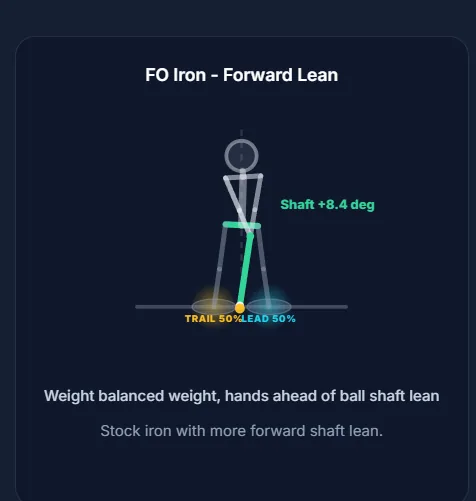
| Delivery Measurement | Tour Pro Impact | Amateur Flip Strike | Ball Flight Result |
|---|---|---|---|
| Lead Wrist Flexion/Extension | 5° to 15° bowed (flexion) | 15° to 30° cupped (extension) | Clubhead overtakes hands prior to strike |
| Forward Shaft Lean | 8° to 12° forward tilt | -4° to 0° (backward scoop) | Adds 6° to 10° of unintended loft |
| Pelvis Rotation at Strike | 35° to 45° open to target | 0° to 15° stalled/square | Stalled hips force hands to flip early |
| Swing Arc Low Point | 3 to 4 inches ahead of ball | 1 to 3 inches behind ball | Thin hits, fat divots, ballooning distance loss |
Drills to replace the flip with shaft lean
Practice these targeted drills to feel the sensations of a flat lead wrist and continuous body rotation through impact.
Essential anti-flip drills
Build the physical feeling of striking down and leading the handle through the hitting area.

Explore our dedicated fault guides
Connected swing fault guides
Flipping is deeply intertwined with casting and chicken wing follow-throughs.
Frequently asked questions
How much forward shaft lean should an amateur have with a 7-iron?
While tour pros average between 8 and 12 degrees of forward shaft lean with a mid-iron, a realistic target for amateur golfers is 4 to 8 degrees. Any positive shaft lean creates a descending strike and prevents scooping.
Can you fix flipping just by holding your hands forward?
No. Consciously trying to hold your hands forward without rotating your body results in a steep, blocked push or a severe shank. Forward shaft lean is created by continuous chest and pelvic rotation, which pulls the handle naturally ahead of the clubhead.
Sources
- TrackMan Tour Average Impact Conditions Forward shaft lean and angle of attack measurements.
- Titleist Performance Institute Lead Wrist Mechanics Lead wrist flexion/extension measurements at P7 impact.
How AI Golf School Diagnoses Your Swing
Instead of a vague list of swing tips, every analysis isolates your single root-cause fault, tracks 33 skeletal joints in 3D through impact, and pairs you with a focused drill plan.
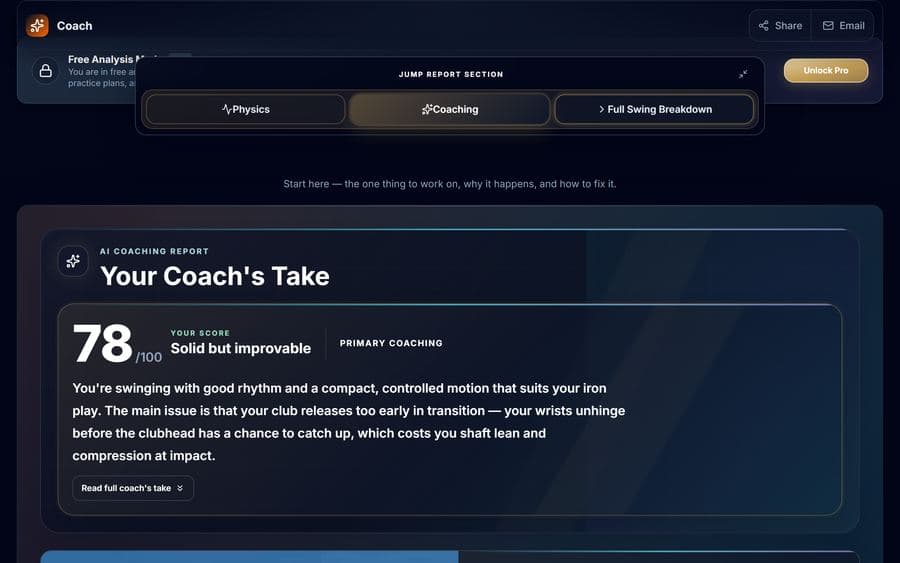
Composite score with root-cause flaw detection and severity ratings.
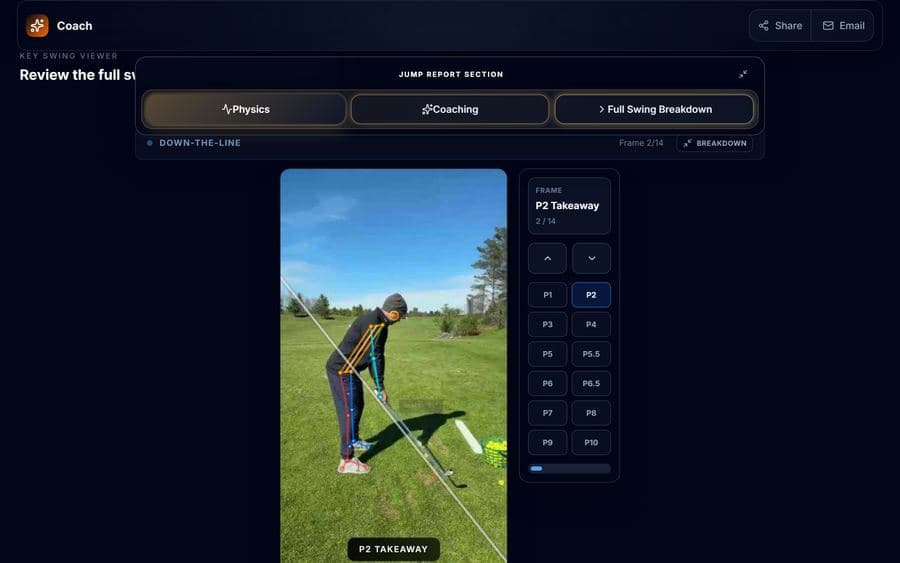
Swing Lens tracks 33 joints across all swing phases.
Personalized drills from certified coaches matched to your specific flaws.
Upload one video from your phone to diagnose your swing mechanics.