Can AI Swing Analysis Apps Replace a Human Golf Coach?
Key takeaways
| Point | Details |
|---|---|
| AI excels at high-speed 3D motion measurement and root-cause isolation | Computer vision tracks 33 body joints frame by frame at 60 to 240 fps, catching transition stalls and spine-tilt shifts that happen too fast for the human eye. |
| Human coaches remain unmatched for green-side feel, course management, and tournament psychology | Bunker turf interaction, uneven lies, and scoring strategy under pressure still benefit from an experienced teaching pro standing beside you. |
| Daily range feedback closes the gap between monthly lessons | Most golfers forget 70 percent of a one-hour lesson within a week; an AI analyzer lets you verify after every 10 balls whether your drill is actually changing the fault. |
| The smartest modern practice setup pairs both | Using AI Golf School for $10 to $15 a month on the range while booking occasional check-ins with a teaching pro cuts annual instruction costs by 80 percent. |
Quick answer
AI swing analysis apps can replace a human coach for full-swing video diagnosis and day-to-day range practice, where 3D computer vision tracks joint angles and isolates your root-cause fault faster and for a fraction of the price. Human coaches still hold the edge in short-game touch, uneven course lies, and mental strategy.
Five years ago, asking whether software could replace a golf instructor was a joke. Early swing apps were little more than slow-motion video players that let you draw yellow lines on your screen. If you did not already know what position P5 or P6 was supposed to look like, the lines meant nothing.
In 2026, computer vision and 3D pose estimation have changed the equation completely. A modern phone shoots 240 frames per second, and multi-model AI pipelines track 33 skeletal landmarks in 3D space without a single wearable sensor. That shift makes it worth asking honestly: what does a $150-per-hour human lesson still give you that an AI swing coach does not, and where has the software actually passed the naked eye?
Where AI swing analysis beats the human eye
The downswing from the top of the backswing (P4) to impact (P7) takes roughly 0.25 seconds. Even a seasoned teaching professional standing on the range tee cannot see whether your pelvis stalled 40 milliseconds before your trail wrist released, or whether your spine angle lost 4 degrees of tilt during transition. They have to film you, scrub the clip by hand, and eyeball the angles.
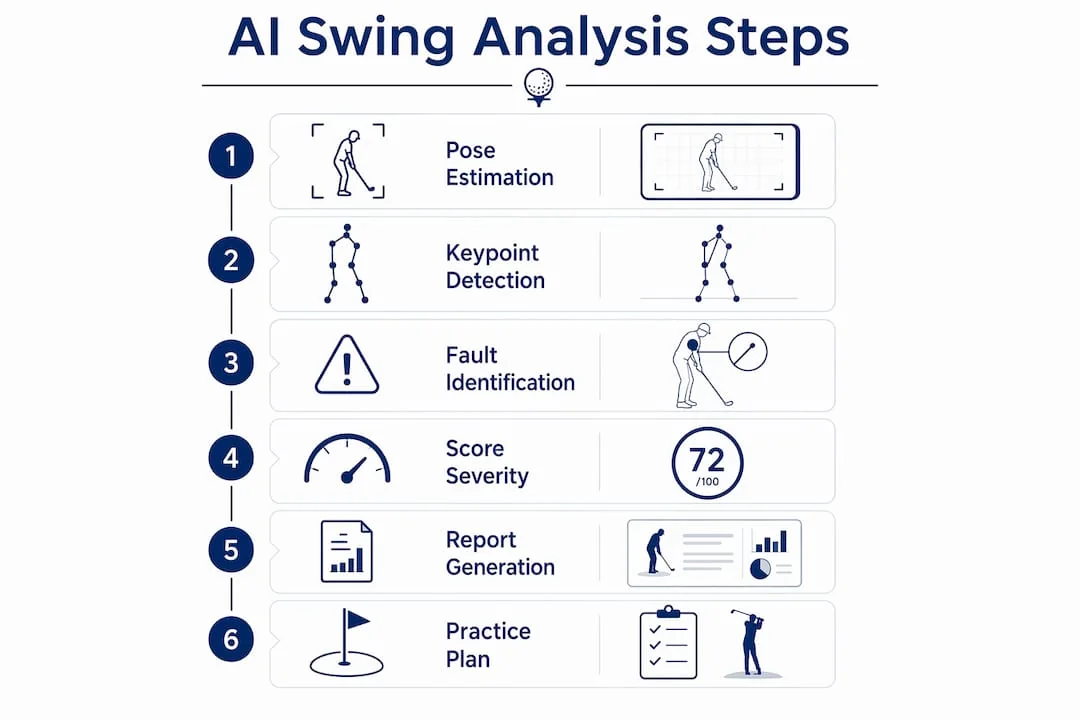
- Objective root-cause sorting: Instead of listing five things wrong with your impact position, AI Golf School traces the kinematic chain backward to find the earliest fault that forced your body to compensate.
- Zero scheduling friction: Your worst swing slumps happen on Friday afternoon before a Saturday tee time, not three weeks later when your coach has an open slot.
- Longitudinal tracking on every practice session: You can film one swing after every 15 balls to verify that your feel is actually producing real change on camera.
| Coaching Dimension | AI Golf School (3D AI) | In-Person PGA Pro | Online Video Coach |
|---|---|---|---|
| Feedback Turnaround | Under 2 minutes on the range | Real-time during booked hour | 24 to 72 hours per upload |
| 3D Joint & Plane Measurement | 33 joints tracked every frame | Visual estimate (unless studio GEARS) | 2D telestration lines on video |
| Typical Cost | Free first analysis; ~$12/month | $100 to $200 per 60-minute lesson | $80 to $250 per month |
| Short Game & Course Strategy | Full-swing & setup mechanics | Excellent (bunkers, rough, green reading) | Limited to filmed range swings |
Where a human golf coach still wins
Software measures motion, not turf or temperament. There are three areas where a skilled human coach remains worth every dollar.
- 1
Short-game turf interaction and bunker play
Hearing how the bounce of a sand wedge thuds into wet sand versus tight Bermuda grass requires standing beside the green and watching the divot and spin firsthand.
- 2
Physical hands-on kinesthetic positioning
When a golfer has zero body awareness of what a neutral P4 top position feels like, a coach physically moving the club into position once can save a hundred range balls.
- 3
On-course playing lessons and shot selection
Breaking 80 is often about picking conservative targets away from short-sided trouble, reading wind, and managing nervous energy under tournament pressure.
Interactive Face & Path Lab (Right-Handed)
Instant visual translation from swing mechanics to ball flight
Push draw
- Club path:
- In to out
- measured from your swing
- Face at impact:
- Open to the target, closed to the path
- worked out from where your ball started and how it curved
- Ball flight:
- Starts right, curves left (draw spin)
- what you reported
Face Angle
+1.5°
~80% of start line
Club Path
+3.5°
In-to-out
Face to Path
-2.0°
Face - Path = Curve
Start line: Starts slightly right (Face Angle +1.5°)
Curve: Draws gently back left (Face is -2.0° closed to path)
Foundational drills every coach (human or AI) prescribes
Core sequence and tempo drills
Whether you work with an AI analyzer or a teaching pro, these three drills build a connected, repeatable pivot.


Explore our fault diagnosis guides
See how 3D analysis breaks down the most common full-swing faults.
Frequently asked questions
Can AI swing analysis apps replace a human golf coach?
For full-swing video diagnostics and between-lesson range practice, yes. AI swing analyzers measure 3D joint angles, sequence, and swing plane more consistently than the naked eye and prescribe specific drills immediately. However, a human coach is still better for short-game touch, uneven on-course lies, and mental game strategy.
Is there an app that gives instant feedback on my swing mechanics?
Yes. AI Golf School runs directly in your phone browser without sensors or extra hardware. You upload a down-the-line or face-on clip and receive a 3D skeletal breakdown, a single root-cause fault diagnosis, and matched practice drills in under two minutes.
Why do some golfers struggle with AI golf apps?
Older apps dump 15 disconnected angle measurements on the screen at once, which overwhelms the player. AI Golf School separates the physics engine (the Oracle) from the coaching layer (Caddie Vision) so the report highlights the single root cause driving your compensations.
How much money does AI golf coaching save compared to traditional lessons?
A typical PGA teaching professional charges $100 to $200 per hour, meaning bi-weekly lessons cost $2,400 to $4,800 per year. An annual AI coaching membership costs less than a single one-hour in-person lesson while providing unlimited range check-ins.
Sources
- PGA of America Teaching and Coaching Survey Benchmarks Average lesson rates and student retention intervals across US golf facilities.
- Titleist Performance Institute (TPI) 3D Biomechanics vs 2D Video Why 3D joint tracking catches pelvis and thorax rotation errors hidden on 2D video.
How AI Golf School Diagnoses Your Swing
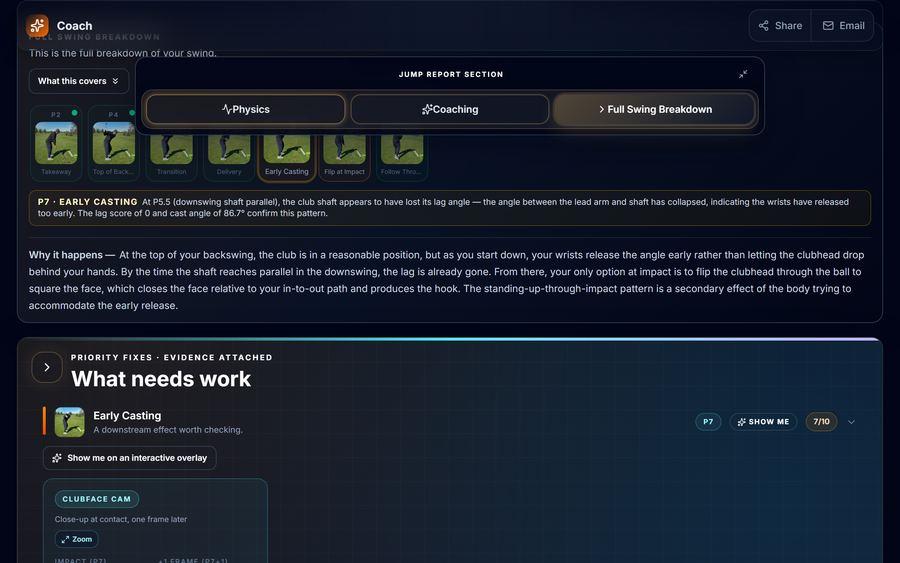
Instead of a vague list of swing tips, every analysis isolates your single root-cause fault, tracks 33 skeletal joints in 3D through impact, and pairs you with a focused drill plan.
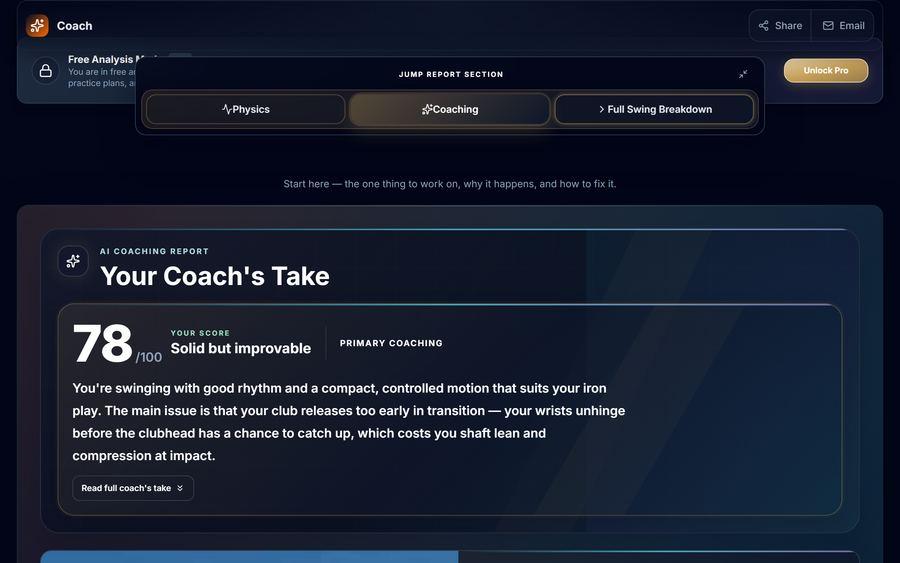
Composite score with root-cause flaw detection and severity ratings.
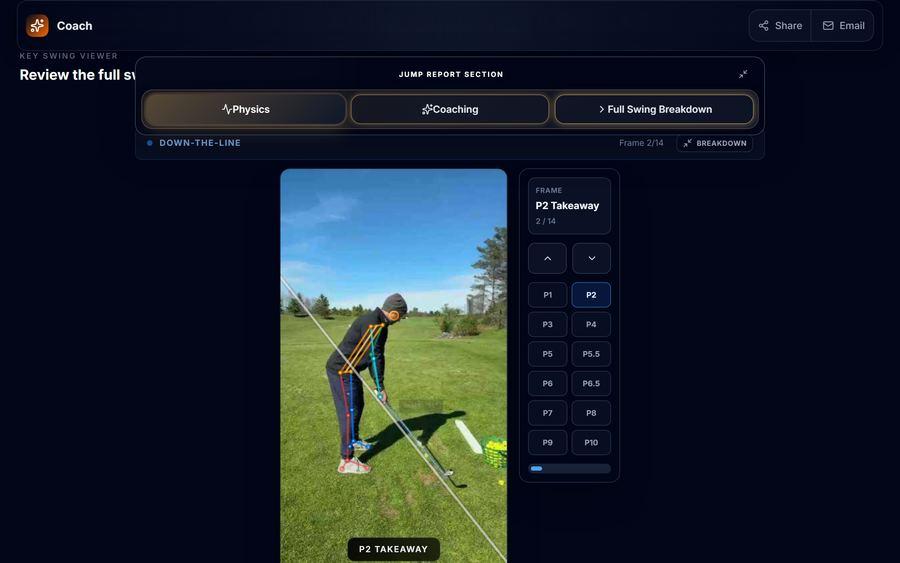
Swing Lens tracks 33 joints across all swing phases.
Personalized drills from certified coaches matched to your specific flaws.
Upload one video from your phone to diagnose your swing mechanics.