Winter Golf Practice Plan: How to Stay Sharp and Lower Your Handicap on a Simulator
Key takeaways
| Point | Details |
|---|---|
| Structure beats ball volume indoors | Hitting 45 purposeful balls across four timed blocks improves your swing faster than raking 120 balls off a mat. |
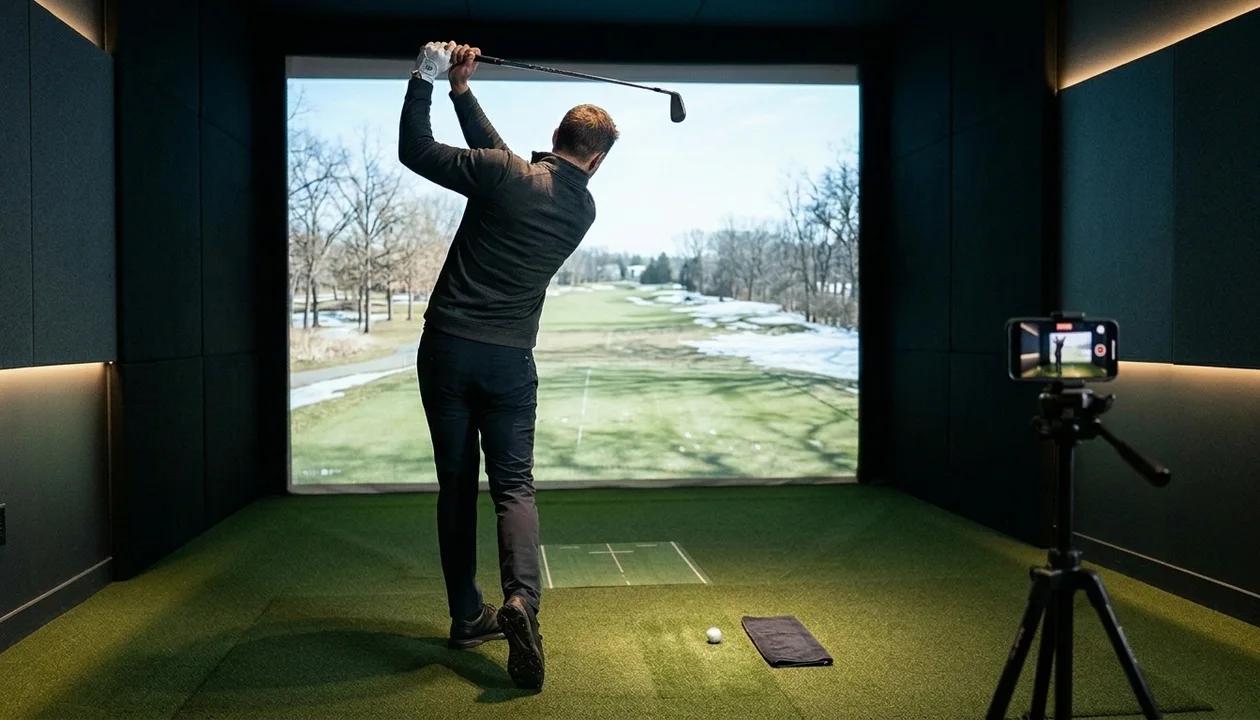
| Always protect against forgiving mats | A flat towel placed four inches behind the ball immediately exposes heavy contact that indoor turf normally hides. |
| Combine bay numbers with phone video | Simulators show club path and ball flight, while AI Golf School shows the P1 to P10 body sequence causing those numbers. |
| Finish every session with random targets | Switching clubs and targets for the final 15 minutes forces your winter drill work to transfer onto real grass in spring. |
Quick answer
The best winter golf practice plan divides a 60-minute simulator session into four blocks: 10 minutes to warm up and film one baseline swing for AI Golf School, 25 minutes on a single root-cause drill with a towel behind the ball to prevent mat-induced fat shots, 10 minutes to re-film and verify the body change, and 15 minutes of randomized club-switching or simulated holes.
If you live in Canada or the northern United States, winter gives you four to five months without scorecard pressure. That off-season window is the easiest time of year to make a lasting mechanical change, yet most golfers waste it by raking 100 balls in 45 minutes with a 7-iron and chasing distance numbers on the projector screen.
Why mindless simulator sessions backfire in the spring
- Forgiving mats hide fat shots: Thick indoor turf lets the clubhead bounce into the ball even when you hit two inches behind it, masking low-point and early-release faults until your first muddy April round.
- Block practice builds false confidence: Hitting 30 straight 7-irons off a flat mat with the same target feels great indoors, but real golf requires switching clubs and target lines on every single swing.
- Numbers without body feedback create guessing: Seeing a -5 degree club path or a 1.24 smash factor on screen tells you what happened at impact, not which body position between P1 and P7 caused it.
The 60-minute winter indoor practice blueprint
| Block | Time | Focus | What to Measure |
|---|---|---|---|
| 1. Baseline & Film | Min 0 to 10 | 10 half-wedges, 5 full 7-irons, film 1 DTL swing on a phone tripod | Upload clip to AI Golf School + note bay club path and smash factor |
| 2. Root-Cause Drill | Min 10 to 35 | Work ONE prioritized fault using slow reps then 75% swings | Place a flat towel 4 inches behind the ball so heavy hits show up immediately |
| 3. Re-Film Check | Min 35 to 45 | Film 1 full-speed swing from the exact same tripod spot | Confirm your P1 to P10 body angles actually moved, not just your feel |
| 4. Random Transfer | Min 45 to 60 | Switch clubs every shot (driver, 7-iron, 90-yard wedge) or play 3 to 6 holes | Track fairways, greens, and dispersion rather than peak carry distance |
How to pair AI Golf School with any indoor simulator
You do not need a $3,000 winter coaching package to get real feedback inside a commercial simulator bay. Bring a compact phone tripod, set it 8 to 10 feet behind your hands at waist height, and record a single down-the-line swing during your warm-up. While you stretch or hit a few wedges, upload that clip to AI Golf School.
Within a minute, AI Golf School maps your P1 through P10 positions, ranks your primary root-cause fault, and assigns a targeted drill. You can also plug your simulator screen numbers into our free TrackMan Numbers Interpreter and Smash Factor calculators to confirm whether your club path, face angle, and compression are moving in the right direction during Block 2 and Block 3.
Monthly winter progression (November to March)
- 1
Month 1 (Nov - Dec): Audit and fix your #1 fault
Pick one structural issue from your AI Golf School baseline scan, such as an over-the-top transition or early extension, and dedicate 60% of your bay time to owning that single move.
- 2
Month 2 (Jan): Build compression and wedge distance control
Dial in 7-iron smash factor toward 1.30+ and build a 3-wedge distance matrix (50, 75, and 100 yards) using the simulator's carry readout.
- 3
Month 3 (Feb - Mar): Shift to 50/50 drill work and simulated course play
Spend the second half of every session playing 9 simulated holes with full pre-shot routines so your mechanical fix holds up under target pressure.
Not sure which local facility has the best launch monitor for winter practice? Compare US and Canadian venues in our 2026 indoor golf simulator chains review, or learn how to translate simulator numbers into real swing fixes.
Top swing faults to fix during the off-season
Winter is the ideal time to clean up the three faults that cost mid-handicappers the most strokes.
Frequently asked questions
How often should I practice on a golf simulator in the winter?
One to two 60-minute simulator sessions per week, paired with two short 10-minute mirror or drill sessions at home, is enough for most amateurs to drop 3 to 5 strokes before spring without risking mat-related wrist or elbow overuse.
Can practicing on an indoor golf mat hurt my real-grass ball striking?
Yes, if you hit fat shots without realizing it because the clubhead bounces off the mat into the ball. Placing a flat towel or strip of tape four inches behind the ball forces crisp ball-first contact that transfers directly to real turf.
How do I use AI Golf School inside a simulator bay?
Set a phone tripod 8 to 10 feet behind your hands at waist height, film one down-the-line swing during your warm-up, and upload it to AI Golf School. Use the ranked fault and matched drill for the middle 25 minutes of your bay hour, then re-film once to verify the change.
Should I play virtual golf rounds or use the driving range mode in winter?
Use driving range mode for the first 35 to 45 minutes to work on one swing fault and verify your metrics, then spend the last 15 minutes playing 3 to 6 simulated holes so you practice switching clubs and committing to targets.
How AI Golf School Diagnoses Your Swing
Instead of a vague list of swing tips, every analysis isolates your single root-cause fault, tracks 33 skeletal joints in 3D through impact, and pairs you with a focused drill plan.
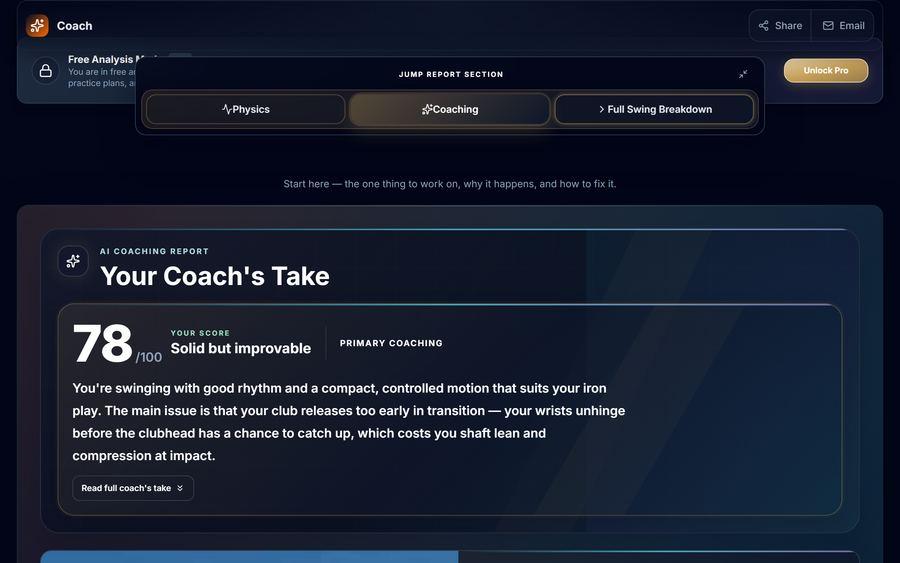
Composite score with root-cause flaw detection and severity ratings.
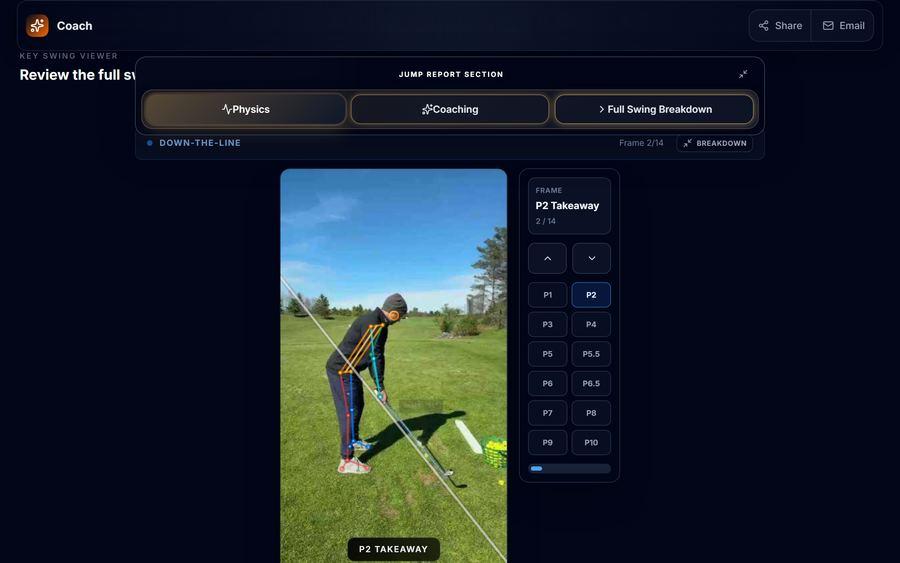
Swing Lens tracks 33 joints across all swing phases.
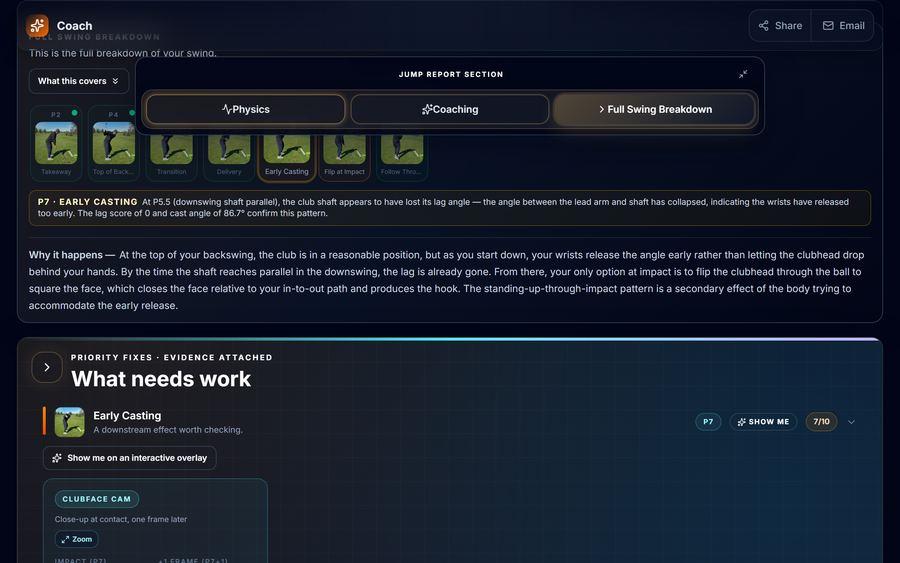
Personalized drills from certified coaches matched to your specific flaws.
Upload one video from your phone to diagnose your swing mechanics.